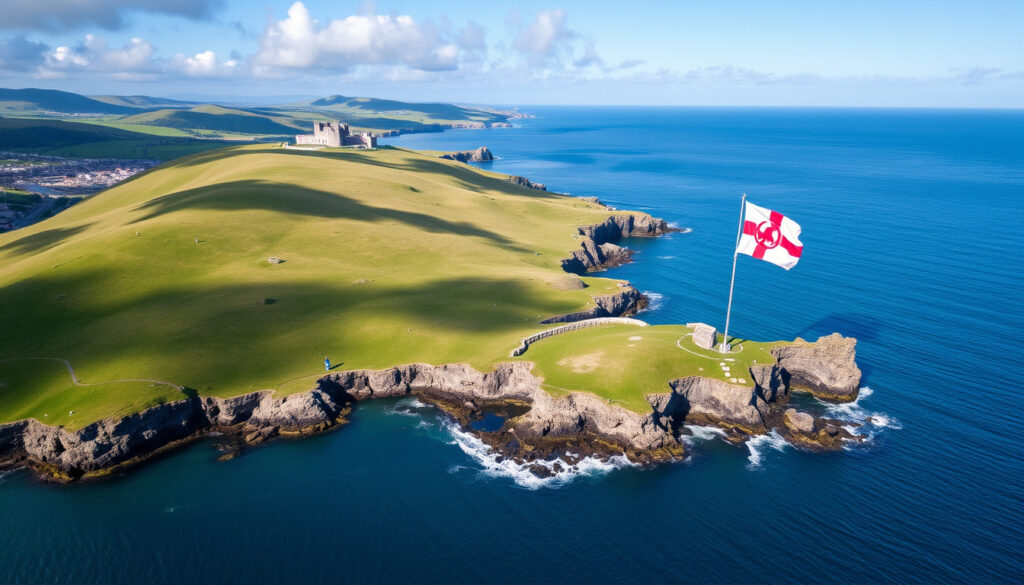
Isle of Man: A Crown Dependency, Not Part of the UK
Few islands in the British Isles spark as much confusion as the Isle of Man. Sitting squarely in the Irish Sea, equidistant from England, Ireland, Scotland, and Wales, its political identity is just as central and just as distinct. Understanding exactly what the Isle of Man is — and isn’t — requires a closer look at its unique constitutional status.
Population (2021 census): 84,069 · Area: 572 km² (221 sq mi) · Capital: Douglas · Currency: Manx pound (parity with GBP) · Government status: Crown dependency · Official language: English, Manx (Gaelic)
Quick snapshot
- Isle of Man is a Crown dependency, not part of the UK or EU. (Isle of Man Government)
- It is self-governing with its own parliament, Tynwald. (Manx National Heritage)
- Exact date of first human settlement (estimated before 6500 BC).
- Origin of the name “Man” — possibly from Manannán mac Lir.
- Constitutional system introduced around 800 AD. (The Royal Family)
- Isle of Man purchased by the British Crown in 1765. (Britannica)
The Isle of Man’s distinct status is built on a set of concrete facts. Here is the essential profile.
| Attribute | Detail |
|---|---|
| Official name | Isle of Man (Ellan Vannin) |
| Capital | Douglas |
| Population (2021) | 84,069 |
| Area | 572 km² (221 sq mi) |
| Currency | Manx pound (GBP equivalent) |
| Government | Crown dependency with self-government |
| Parliament | Tynwald (founded 979 AD) |
| Languages | English, Manx Gaelic (recognised) |
| Time zone | GMT (UTC+0), summer BST (UTC+1) |
| Driving side | Left |
The implication: the Isle of Man operates as a near-sovereign entity in domestic matters, even within its small physical footprint.
Is the Isle of Man part of the UK?
What is the political status of the Isle of Man?
- The Isle of Man is a self-governing British Crown Dependency, which means it is not part of the United Kingdom. (Isle of Man Government official constitution page)
- It has its own parliament, government, and legal system. Tynwald has been in continuous existence for over a thousand years. (Manx National Heritage)
- The island is one of three Crown Dependencies, alongside Jersey and Guernsey. (The Royal Family)
How does the Isle of Man relate to the United Kingdom?
- The UK government is responsible for the island’s defence and international relations. (GOV.UK Crown Dependencies page)
- Isle of Man residents are British citizens. The island is not a member of the European Union. (BBC News Isle of Man profile)
- The British monarch is styled Lord of Mann, and the Crown’s personal representative is the Lieutenant Governor. (The Royal Family)
The implication: the Isle of Man is a distinct jurisdiction with a direct line to the Crown, not a county or region of the UK.
Was the Isle of Man ever Irish?
What is the historical connection between the Isle of Man and Ireland?
- The island was part of the Gaelic world, speaking Manx, a Goidelic language closely related to Irish and Scottish Gaelic. (Britannica)
- Its early medieval kingdom was part of the Kingdom of Mann and the Isles, a sea-kingdom stretching across the Irish Sea. (Manx National Heritage)
- It was never formally part of the Irish state.
Did the Isle of Man ever belong to Ireland?
- The Isle of Man was permanently settled by Celts and fell under Viking control in 1079. (BBC News)
- It was later ruled by the Norse, Scotland, and England at various times. (Manx National Heritage)
- The island historically shared Celtic heritage with Ireland but did not come under formal Irish political control.
The pattern: a shared Celtic lineage rather than political union. The island’s Gaelic past is genuinely rich, but its modern identity is independent of the Republic of Ireland.
What is so special about the Isle of Man?
What is the Isle of Man famous for?
- It is world-famous for the Isle of Man TT motorcycle races, a legendary annual event on public roads. (BBC News)
- It is home to the Laxey Wheel, the largest working waterwheel in the world, and the tailless Manx cat. (Britannica)
- Tynwald, the island’s parliament, is one of the oldest continuously running parliaments in the world, predating the English Parliament at Westminster. (Manx National Heritage)
What cultural and natural attractions does it offer?
- The unique Manx Gaelic language and culture are actively promoted and officially recognised. (Isle of Man Government)
- Scenic landscapes include coastal cliffs, glens, and the Snaefell mountain range.
- Historic attractions such as Peel Castle and the Cregneash living village preserve the island’s heritage.
The implication: the island packs an enormous amount of identity into a small space. From a parliament older than Westminster to a globally broadcast motorcycle race, its fame is earned through genuine uniqueness.
How much money do I need to live in the Isle of Man?
What is the cost of living in the Isle of Man?
- The cost of living is comparable to southern England, though housing and fuel are notably higher. (BBC News)
- Typical monthly rent for a one-bedroom apartment in the capital, Douglas, ranges from £600 to £900.
- Proof of income or savings is required for visa applications for non-UK/Irish citizens.
For a UK resident earning £100,000, moving to the Isle of Man can mean a significant tax saving due to the absence of inheritance tax, capital gains tax, and the island’s capped income tax rate. But that saving often goes straight into higher housing costs — a one-bedroom apartment in Douglas averages around £700 a month.
Are there any tax advantages?
- There is no capital gains tax, no inheritance tax, and low income tax rates on the island. (Isle of Man Government)
- These advantages make it particularly attractive for high earners, retirees, and business owners.
The catch: lower taxes versus higher housing costs. For high earners and retirees, the balance often tips in the island’s favour. For those on median incomes, the arithmetic is tighter.
Is the Isle of Man expensive to visit?
What are the average costs for a trip to the Isle of Man?
- Ferry and flight costs from the UK and Ireland vary, typically ranging from £50 to £150 for a return trip.
- Accommodation ranges from around £80 per night for budget hotels and guesthouses.
- Attractions such as museums and castles have modest entry fees, usually between £5 and £15.
- Dining out is broadly similar to UK prices.
During the TT race fortnight, the island’s population temporarily swells by over 40,000 visitors. Hotel rates can triple, and ferry crossings sell out months ahead. For a local rider, the TT is a world-class event; for a budget traveler, it is the single biggest cost multiplier on the island.
How can I save money when visiting?
- Book ferry crossings and accommodation well in advance, especially if travelling during race weeks.
- Explore the island’s free natural attractions — coastal walks, glens, and beaches cost nothing.
- Consider visiting outside the TT season for significantly lower prices and quieter roads.
The pattern: for the budget-conscious traveler, timing is everything. Outside the TT fortnight, the island offers solid value; during it, prices reflect global demand for the event.
Isle of Man at a Glance: Specs & Figures
Beyond the headlines, the island’s practical specs reveal a well-structured jurisdiction.
| Spec | Detail |
|---|---|
| Highest point | Snaefell (620 m / 2,034 ft) |
| Coastline | ~160 km |
| Internet TLD | .im |
| ISO 3166 code | IM |
| Calling code | +44-1624 |
| Electricity | 230 V, 50 Hz (Type G plug) |
| Time zone | GMT (UTC+0), BST (UTC+1) |
| Driving side | Left |
The implication: these specs paint a picture of a small but thoroughly modern jurisdiction that mirrors British infrastructure while maintaining its own digital and legal identity.
Living on the Isle of Man: The Pros and Cons
Upsides
- Low taxes: no capital gains tax, no inheritance tax, capped income tax
- High safety and low crime rates
- Beautiful natural landscapes and coastal walks
- Strong sense of community and cultural identity
Downsides
- Higher cost of housing and fuel compared to many UK regions
- Limited job market outside the finance and tourism sectors
- Remote location necessitates ferry or air travel for major connections
- Small population may feel isolating for some
The pattern: the choice for any potential mover is a personal one — the island’s tax and lifestyle benefits are real, but they come with the constraints of a tight housing market and a small community.
A Timeline of the Isle of Man’s History
Key events that shaped the island’s distinct constitutional path.
| Date | Event |
|---|---|
| c. 800–1265 | Viking rule; Kingdom of Mann and the Isles. (Britannica) |
| 1266 | Treaty of Perth transferred control to Scotland. (Manx National Heritage) |
| 1405–1736 | Stanley family ruled as Lords of Mann. |
| 1765 | Isle of Man purchased by the British Crown. (Britannica) |
| 1866 | Restoration of self-government under Tynwald. (Isle of Man Government) |
| 1973 | UK joined the EEC; Isle of Man did not join. (BBC News) |
| 2007 | Manx language officially recognised. |
The pattern: a gradual assertion of self-rule, always under the umbrella of the Crown.
What We Know and What Remains Unclear
Confirmed facts
- Isle of Man is a Crown dependency, not part of the UK. (Isle of Man Government)
- It is not part of the Republic of Ireland.
- It has its own parliament and legal system. (BBC News)
- Population ~84,000, area 572 km².
What’s unclear
- Exact date of first human settlement (estimated to be before 6500 BC).
- Origin of the name “Man” – possibly from the sea god Manannán mac Lir.
- Historical extent of Irish political control in the early medieval period (debated).
The implication: the confirmed facts provide a solid foundation for understanding the island’s status. The unanswered questions remind us that some of the Isle of Man’s oldest stories are still being written by historians and archaeologists.
Expert Perspectives on the Isle of Man
“The Isle of Man is a self-governing British Crown Dependency.”
— Isle of Man Government official constitution page
“The Isle of Man is a Crown dependency, which means it is not part of the United Kingdom.”
— BBC News Isle of Man profile
“The island was permanently settled by Celts and fell under Viking control in 1079.”
— Britannica Isle of Man entry
The pattern: across all the expert accounts, one theme is consistent — the Isle of Man’s identity is defined by its unique, centuries-old constitutional arrangement.
Summary
For a British expat weighing the move, the decision hinges on tolerance for trade-offs: a lower tax bill against a smaller job market and pricier housing. For the Irish or British tourist, the island offers a weekend’s worth of unique culture and landscapes that feel genuinely separate from the mainland. The implication: the Isle of Man demands a deliberate choice — you don’t just end up there by accident.
Related reading
- William the Conqueror: Life, Reign, and Legacy – Explore the era of Norman rule that overlapped with the Viking period on the Isle of Man.
- Captain Hook: Irish Evil, Queer Coding – Delve into the cultural representation of characters rooted in the Irish Sea region.
en.wikipedia.org, historic-uk.com, legislation.gov.im, reddit.com, en.wikipedia.org, manxnationalheritage.im
Frequently asked questions
What is the Isle of Man best known for?
The Isle of Man is best known for the annual Isle of Man TT motorcycle races, its ancient parliament Tynwald, the tailless Manx cat, and the Laxey Wheel.
Do I need a visa to move to the Isle of Man?
UK and Irish citizens do not need a visa to live, work, or retire on the Isle of Man. Other nationals typically require a visa, following UK immigration rules.
Is the Isle of Man a tax haven?
The island has low taxes — no capital gains tax, no inheritance tax, and a capped income tax rate — but it is not officially listed as a tax haven and cooperates with international tax standards.
What language do they speak in the Isle of Man?
English is the main spoken language. Manx Gaelic, a Goidelic Celtic language, is a recognised regional language and has seen a revival in recent years.
What is the weather like on the Isle of Man?
The Isle of Man has a temperate maritime climate, similar to the rest of the British Isles. Winters are cool and damp, summers mild, with moderate rainfall throughout the year.
How do I get to the Isle of Man from Ireland?
Regular ferry services operate from Dublin and Belfast to Douglas. Seasonal flights are also available from Dublin and Belfast airports to the Isle of Man.
Is the Isle of Man safe for tourists?
Yes, the Isle of Man is considered very safe for tourists. Crime rates are low, and the island has a strong community feel, making it a secure destination for solo and family travel.
More related posts
 Unforgotten Season 6 – Release Dates Cast Renewal
 Jim Chalmers: Biography, Wife, Religion, Faction, Qualifications
 Emma Watson: Personal Life, Career & Why She Left Acting
 VPN vs. Proxy: What’s the Difference
 Cameron Monaghan: Biography, Relationships, Career Facts
 How Many Billionaires in the World? 3,428 in 2026 Forbes List
 Paul Mescal: Relationship, Net Worth, Movies & Facts
 Latrell Mitchell Injury Update 2026: Career & Family
