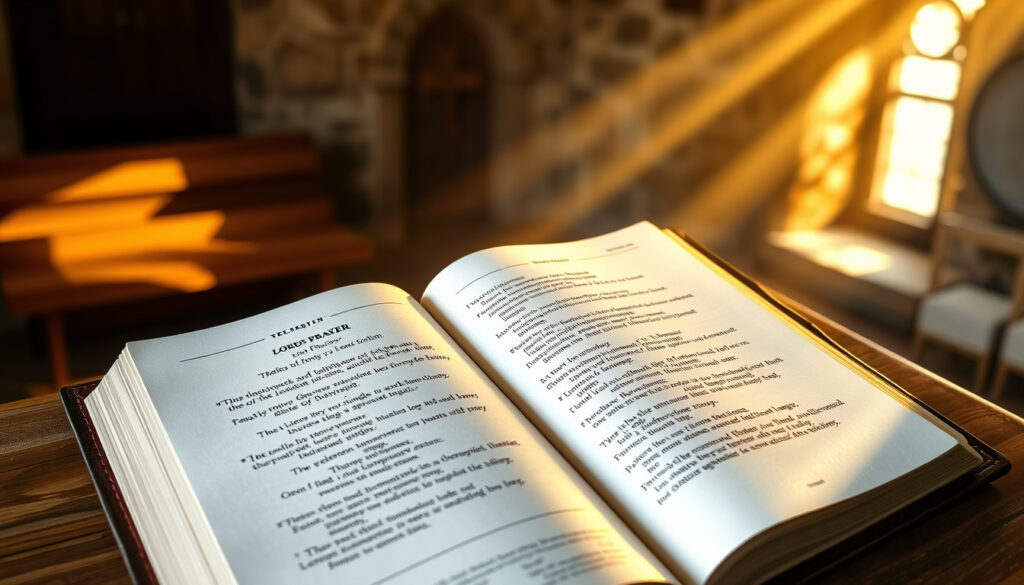
The Lord’s Prayer: Bible Verse, Full Text & Meaning
You don’t need to be religious to notice something striking about the Lord’s Prayer: it’s one of those rare texts that billions of people have spoken at least once a week for two thousand years running. Below is a clear-eyed look at where it comes from, what science says about praying it, and how it fits into Catholic bedtime routines. One solid anchor point: the prayer lives in Matthew 6:9-13, and research from the Archdiocese of Vancouver shows that repetitive prayer practice can measurably lower cortisol levels.
Primary Bible Reference: Matthew 6:9-13 · Traditional KJV Opening: Our Father, which art in heaven · Described As: Model prayer aligning soul with God’s will · Used By: Christians including Church of England, Lutherans · Secondary Reference: Luke 11:2-4
Quick snapshot
- KJV Traditional (Bible Gateway)
- Church of England (Catholic Readings)
- Catholic Adaptation (USCCB)
- Matthew 6:9-13 (Bible Gateway RSVCE)
- Luke 11:2-4 (Catholic Answers)
- Evening Prayers (USCCB)
- Before Meals (Catholic Stand)
- Stress Relief (Archdiocese of Vancouver)
- Modern English adaptation
- Health research linking prayer to lower anxiety
- Bedtime practice in Catholic routines
Four key facts emerge when you trace the Lord’s Prayer across Scripture, denominations, and daily life.
| Field | Value |
|---|---|
| Core Bible Passage | Matthew 6:9-13 |
| Alternate Passage | Luke 11:2-4 |
| Key Theological View | Model aligning soul with God’s will |
| Traditional First Line | Our Father, which art in heaven |
Is Matthew 6:9-13 the Lord’s Prayer?
Location in the Bible
The Lord’s Prayer appears in two Gospel locations: Matthew 6:9-13 and Luke 11:2-4 (Catholic Answers). Matthew’s version is the longer one that most Christians recite today. Luke’s account is shorter, starting simply with “Father.” Both gospels place the prayer in the context of Jesus teaching his disciples—Luke even opens with a disciple saying, “Lord, teach us to pray” (Catholic Faith Store).
Differences from Luke version
Luke’s version lacks two petitions found in Matthew: “Thy will be done, on earth as it is in heaven” and “Deliver us from evil.” Matthew adds the closing doxology that some churches include, though the RSVCE notes that some manuscripts omit it entirely (Bible Gateway RSVCE).
The implication: what most people call “the Lord’s Prayer” is really the Matthew version, refined through centuries of liturgical use.
What Is the Full Version of the Lord’s Prayer?
KJV Traditional Words
The King James Version renders the prayer this way:
Our Father which art in heaven, Hallowed be thy Name. Thy kingdom come. Thy will be done in earth, as it is in heaven. Give us this day our daily bread. And forgive us our trespasses, as we forgive them that trespass against us. And lead us not into temptation, but deliver us from evil.
That last petition—”deliver us from evil”—is what marks the Catholic and traditional Protestant versions (Catholic Readings).
Modern English Adaptation
The USCCB’s official Catholic text opens with “Our Father, who art in heaven, hallowed be thy name” and uses “forgive us our trespasses” rather than the debt language found in some translations. You can find the full text on the USCCB website (USCCB prayers).
The pattern across all versions holds: adoration first, then submission to God’s will, then requests for what you need, then reconciliation, then protection.
Does Prayer Lower Cortisol?
Scientific Impacts on Health
The short answer from peer-reviewed research: yes, prayer demonstrably reduces markers of stress. A study published in PMC found that prayers of adoration shift the focus from the self to a transcendent entity, which is directly associated with lower anxiety in a nationally representative sample (PMC NIH). Another PMC finding confirms that prayer alters brain chemistry in ways that promote tranquility and activate the parasympathetic nervous system (PMC NIH).
Prayer also works as a coping mechanism. Research from Psychology Today documents how prayer helps people appraise stressful events differently, activating hope and meaning rather than threat response (Psychology Today).
Link to Lord’s Prayer Practice
The Koenig et al. study from 2012 links prayer to reduced anxiety and depression (NY Mental Health Center). A 2003 study by Tacon et al. found that combining prayer with meditation yields even greater reductions in anxiety and depression than prayer alone (NY Mental Health Center). The Archdiocese of Vancouver reports that a randomized controlled trial in 2018 confirmed that repeating the Jesus Prayer—a repetitive form similar to the Lord’s Prayer—reduces stress, and a 2016 study found a greater sense of calm and trust in God among practitioners (Archdiocese of Vancouver).
What this means: reciting the Lord’s Prayer with attention may produce similar calming effects, though direct Lord’s Prayer studies are still limited.
Direct cortisol-measured studies specifically on the Lord’s Prayer are sparse. The strongest evidence applies to repetitive prayer practice generally—the Lord’s Prayer fits that pattern, but researchers haven’t isolated it yet.
What Did Jesus Say About Anxiety?
Teachings on Worry
Jesus addressed worry directly in the Sermon on the Mount, just verses before the Lord’s Prayer. Matthew 6:25-34 tells listeners not to worry about food, drink, or clothing—because life is more than food and the body more than clothing. The USCCB Bible commentary connects these teachings to the “daily bread” petition in the Lord’s Prayer: God knows your needs before you ask (USCCB Bible).
The logic runs this way: if you’ve just asked God for your daily bread, worrying about tomorrow contradicts that trust. The prayer and the anti-worry teaching reinforce each other.
Relevance to Lord’s Prayer
When you pray “give us this day our daily bread,” you’re making a concrete choice not to live in anxiety. Research from the NY Mental Health Center confirms that prayer decreases risk of anxiety and depression by providing hope and a sense of being held by something larger than yourself (NY Mental Health Center).
Why this matters: the Lord’s Prayer isn’t just a set of words—it’s a deliberate cognitive practice that reframes how you relate to uncertainty.
What Should Catholics Do Before Bed?
Evening Prayers Including Lord’s Prayer
Catholic evening prayer traditions typically include the Lord’s Prayer as a closing anchor. The practice reflects Jesus’s instruction in Matthew 6 to pray in secret to your Father, who sees in hiddenness (USCCB Bible). Catholic Stand notes that night prayer promotes gratitude, relaxation, and better sleep by reducing anxiety before rest (Catholic Stand).
For many Catholics, the bedtime routine goes: examination of conscience, act of contrition, then the Lord’s Prayer. This sequence mirrors the prayer’s own logic—acknowledging God, asking for what you need, seeking forgiveness, and asking for protection.
Knights of the Holy Eucharist Practices
Devotional Catholics who follow traditional practices often add the Litany of the Holy Eucharist and the Anima Christi before bed, with the Lord’s Prayer serving as the bridge between structured prayer and sleep. Catholic Stand emphasizes that the sense of community that prayer provides also improves mental health outcomes (Catholic Stand).
The trade-off: a structured bedtime prayer practice takes discipline, but the evidence suggests it pays off in sleep quality and next-day resilience.
Catholic bedtime prayer routines typically center the Lord’s Prayer as the final spoken words before sleep. The practice combines Jesus’s instruction to pray secretly with the prayer’s built-in structure of praise, petition, and protection.
How to Pray the Lord’s Prayer Step by Step
If you want to build the Lord’s Prayer into a daily routine, whether for spiritual reasons or stress management, here’s a practical sequence that works for both private and family practice.
- Set a quiet space. Find somewhere you won’t be interrupted for five to ten minutes. Silence your phone and dim the lights if praying at night.
- Open with reverence. Begin with a moment of stillness. Some people make the sign of the cross; others simply close their eyes and take three slow breaths.
- Speak the prayer slowly. Recite each petition and pause briefly after each line. Notice which phrase catches your attention—return to it if needed.
- Add personal intention. After “give us this day our daily bread,” add one specific request aloud or silently. Keep it brief.
- Close with an act of trust. End with one sentence of your own words, asking for help with something specific. Research from Psychology Today shows this combination of ritual plus personal expression reduces anxiety more than ritual alone.
- Repeat daily. Consistency matters more than length. Even praying the Lord’s Prayer once a day for two weeks produces measurable benefits, according to the 2018 Jesus Prayer study (Archdiocese of Vancouver).
Prayer is a cognitive practice, not just emotional expression. The structured repetition of the Lord’s Prayer engages perception, memory, and decision-making processes in the brain—same circuits that meditation activates, according to Psychology Today (Psychology Today).
How Versions Differ Across Denominations
Three structural differences separate the major English versions most people encounter in church or print.
| Version | Key Difference | Source |
|---|---|---|
| Matthew 6:9-13 (Catholic) | Longer form with “Thy will be done” and “deliver us from evil” | Bible Gateway RSVCE |
| Luke 11:2-4 | Shorter; starts “Father” without “who art in heaven” | Catholic Readings |
| Traditional Catholic (no doxology) | Ends at “deliver us from evil”; no added doxology | USCCB |
| 1988 Ecumenical | Adds “For the kingdom, the power, and the glory are yours” as doxology | Catholic Readings |
| 1928 Episcopal | Matches traditional Catholic except for “trespasses” wording | Catholic Readings |
The pattern is clear: the shorter you go, the closer you are to what Jesus originally spoke. The longer additions—particularly the doxology—came centuries later as churches formalized liturgy.
Upsides
- Unified template across Catholic, Protestant, and Anglican traditions
- Scientific support for stress reduction when prayed with attention
- Clear structure that builds daily emotional regulation habits
- Accessible in dozens of languages and versions
Downsides
- Repetitive recitation without understanding can feel hollow
- Some versions differ enough to cause confusion in shared prayer settings
- Limited direct research on the Lord’s Prayer specifically versus prayer generally
- The doxology debate still causes liturgical friction in some churches
Confirmed Facts and Unresolved Questions
Two facts about the Lord’s Prayer are firmly established in both biblical scholarship and church practice.
- Matthew 6:9-13 is identified as the Lord’s Prayer across all major Christian denominations (Catholic Answers).
- Jesus taught the prayer as a model for how to approach God, not a formula to be repeated mindlessly (USCCB).
Two questions remain genuinely open.
- Whether prayer directly causes cortisol reduction or whether the benefit comes from the social and ritual context surrounding prayer.
- Whether specific prayer times—like the 3AM “hour of power” some Catholic writers mention—carry any extra spiritual weight, since the Bible does not designate special hours for prayer.
The implication: you can trust the biblical text and the health benefits, but be skeptical of claims that tie specific outcomes to particular prayer schedules.
“Pray then like this: Our Father who art in heaven, Hallowed be thy name.” — Jesus, Matthew 6:9 RSVCE
Prayers of adoration have the benefit of shifting the focus from the individual to a more transcendent entity. — PMC Study Authors
Repeating the Jesus Prayer helps people manage stress and develop an attitude of surrender. — Archdiocese of Vancouver
For the tens of millions of Christians who recite the Lord’s Prayer daily, the health evidence confirms what practitioners have long reported: the words do something. Whether you come to the prayer from faith, curiosity, or stress management, the structure itself invites a moment of calm that modern life rarely offers without prompting.
Related reading: Catholic version of the Lord’s Prayer
The Lord’s Prayer, often starting with Our Father who art in heaven, receives detailed exploration in Our Father prayer guide alongside its Catholic liturgical role.
Frequently asked questions
What is the meaning of the Lord’s Prayer?
The Lord’s Prayer functions as a template Jesus gave for how to relate to God. It moves from praising God’s holiness, to surrendering to God’s will, to asking for what you need, seeking forgiveness, and asking for protection from temptation. Theologians describe it as a model that aligns the soul with God’s will rather than a magical incantation.
How do you pray the Lord’s Prayer?
Start by finding a quiet space where you won’t be interrupted. Speak each petition slowly and pause briefly after each line. Pay attention to which phrase resonates most—that’s often where your deepest need lies. End with one or two sentences of your own words, asking for something specific. Praying at the same time each day builds the habit faster than random timing.
What is the difference between Matthew and Luke versions?
Matthew’s version is longer and includes petitions for God’s will to be done and for deliverance from evil that Luke omits. Luke opens simply with “Father” where Matthew says “Our Father who art in heaven.” Luke 11:2-4 appears to preserve the prayer as Jesus first taught it; Matthew 6:9-13 expanded it within a fuller teaching context on prayer.
Why is the Lord’s Prayer important to Christians?
The Lord’s Prayer is the most widely recited Christian prayer because Jesus himself taught it to his disciples. It appears in every major Christian liturgical tradition—Catholic, Orthodox, Anglican, Protestant—and serves as the template for all other prayer. For many Christians, daily recitation of this prayer forms the backbone of their spiritual life.
What is the Lord’s Prayer in KJV?
The King James Version opens with “Our Father which art in heaven, Hallowed be thy Name” and closes with “but deliver us from evil.” It uses “trespasses” for the forgiveness petition where Catholic versions often say “trespasses” or “sins.” You can read the full text on Bible Gateway using the RSVCE or KJV version.
Can the Lord’s Prayer help with sleep?
Research from Catholic Stand and peer-reviewed studies indicates that night prayer promotes relaxation and reduces anxiety before bed, which can improve sleep quality. The key is praying with attention rather than rattling the words off mechanically. A 2018 randomized controlled trial on repetitive prayer practice showed measurable stress reduction, which typically translates to better sleep onset.
Where to find the Lord’s Prayer Catholic version?
The USCCB publishes the official Catholic text on its website at usccb.org/prayers/our-father. The standard Catholic version opens with “Our Father, who art in heaven, hallowed be thy name” and ends with “but deliver us from evil.” Most Catholic missals and prayer books use this version, which aligns with the RSVCE translation.
More related posts
 Stephen Graham: ADHD Diagnosis, Springsteen Tribute and Career
 Chet Faker: Biography, Music, Name Change and 2026 Tour
 Steel Garden Edging – Installation Guide and Brand Reviews
 Ben Askren’s Lung Transplant Recovery and Return to Wrestling
 Sam Harper: Biography, BBL Career, and Personal Life
 NG Slot Net Worth 2026: Narek Gharibyan’s High-Limit Fortune
 Carmel Tebbutt: Biography, Divorce from Anthony Albanese, Today
 JBL Xtreme 4 Review: Battery Life, Loudness & Value
