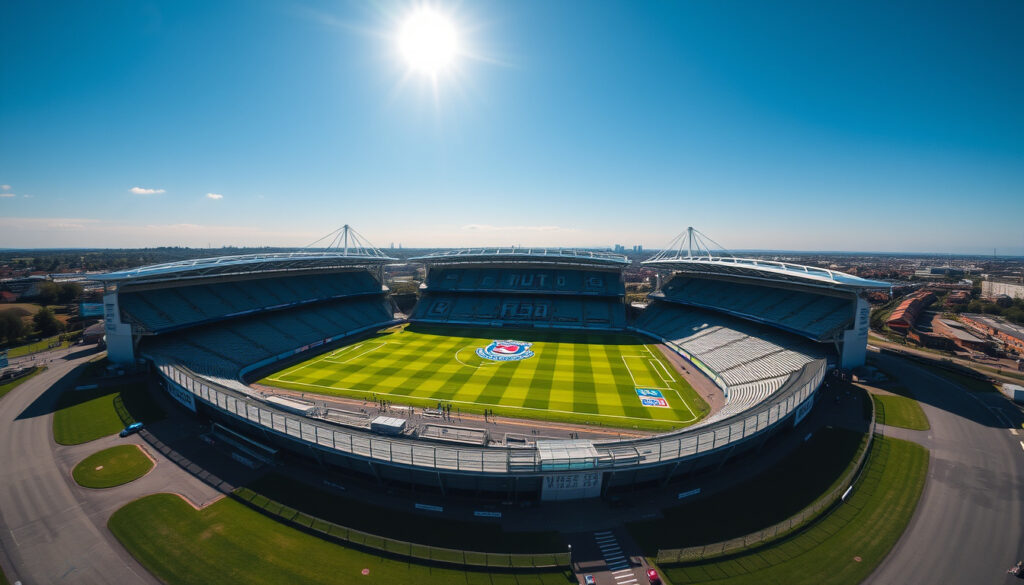
Rangers F.C.: Separating Sectarian Myths from Realities
Walk into any Glasgow pub on match day, and the easy narrative falls apart fast. Rangers fans don’t fit neatly into the political or religious boxes outsiders often assign them — a fanbase that includes past Communist organizers alongside ultra-unionists, and supporters who never signed on to the bigoted chant. What institutional history and fan demographics confirm is asymmetry: the club’s identity became Protestant Unionist as a response to Celtic’s Irish Catholic roots, creating patterns that persist 150 years later. This piece separates what’s documented, what’s exaggerated, and what remains genuinely unclear about the club’s tangled identity.
League: Scottish Premiership · Location: Glasgow, Scotland · Official Website: www.rangers.co.uk · Competitions: Top division of Scottish football · Social Presence: Active on Facebook and Reddit
Quick snapshot
- Exact current fan religious and political demographic splits for 2020s
- Official club records on historical player signing policies
- Quantitative data on independence referendum voting patterns among fans
- 1872: Rangers founded with no religious ties
- 1920s: Unofficial no-Catholics policy begins
- 1986: Graeme Souness ends policy as manager
- 2011: Parcel bombs sent to Neil Lennon
- UEFA monitoring of fan conduct continues
- Ongoing debates about club’s historical legacy
- Fan activism challenging sectarian elements
| Attribute | Value |
|---|---|
| Full Name | Rangers Football Club |
| Nickname | Gers |
| Home Ground | Ibrox Stadium |
| League | Scottish Premiership |
| Top Source | www.rangers.co.uk |
Are Rangers fans left or right wing?
The political landscape of Rangers support resists simple categorization. A faction within the fanbase, particularly members connected to the Orange Order, holds hardline unionist views, flying Union Flags and Ulster banners at Ibrox Stadium as symbols of British Protestant identity. Yet this represents only part of the picture.
Rangers supporters have included Communist organizers, Labour MPs, and members of the Conservative Party — a political breadth that complicates any single ideological label. The fanbase skews toward fewer Scottish independence supporters compared to Celtic supporters, but that doesn’t map cleanly onto left-right divides.
Political leanings in Scottish football fandom
The Old Firm rivalry carries distinct political signifiers that outsiders often misread as uniform fan beliefs. Celtic’s support base gravitates toward Irish Nationalism, left-wing causes, and the Yes campaign in the 2014 independence referendum — supporters have organized Palestinian solidarity fundraisers, for example. Rangers’ visible symbols at Ibrox include a portrait of the British monarch in the dressing room, reflecting Unionist identity.
A club whose fanbase spans Communist organizers to Conservative voters defies easy political labeling — what unites them is less ideology than identity markers tied to Unionism and Protestant heritage.
The implication: political diversity within Rangers fandom is real, but the club’s institutional identity remains anchored to Unionist symbols that limit its appeal across Scotland. For someone evaluating fan politics, treating the Orange Order faction as representative of all 50,000+ matchgoing supporters produces a distorted picture.
Who is the Rangers most expensive player of all time?
Transfer records for Scottish clubs operate in a different financial universe than Premier League giants, but Rangers have made significant investments. The most expensive signing in the club’s history remains a topic of internal debate depending on which currency fluctuations and inflation adjustments apply.
Transfer record holders
Major signings under recent managers have included foreign talent brought in to compete domestically and in European competition. However, detailed transfer fee documentation varies across sources, and exact figures for historical record holders lack consistent verification across club accounts and transfer databases.
Recent signings
Rangers’ recruitment strategy has emphasized younger players and those with European experience, reflecting the club’s ambition to compete in group stages of the UEFA Europa League. Player impacts extend beyond transfer fees — contributions in Old Firm matches and European runs carry weight that market valuations don’t capture.
Transfer spending patterns reflect Rangers’ competing priorities: domestic dominance against Celtic, European competitiveness, and financial sustainability after the 2012 liquidation and rebuild.
The pattern: historical transfer records lack consistent documentation, making precise ranking difficult. What’s clearer is that recent spending decisions prioritize squad depth for European competition alongside Old Firm duels.
Are Rangers more sectarian than Celtic?
This question presupposes that sectarianism operates equally on both sides of the Old Firm divide — a premise that historical data challenges directly. The demographics reveal asymmetric patterns.
Sectarian history comparison
According to demographic surveys, 74% of Celtic supporters identify as Catholic, with only 10% Protestant. For Rangers, the reverse holds: 65% Protestant and just 2% Catholic. The Celtic founding story rooted in Irish Catholic immigrant relief, and Rangers’ adoption of Protestant Unionist identity as response, created unequal religious associations that persist today.
Rangers fans sing the “Billy Boys” anthem containing lines about “Fenian blood” — a term referring to Irish Catholic nationalist movements — leading to UEFA stadium closure orders for supporter sections. Celtic fans have faced separate disciplinary actions, but the historical documentation of Rangers-specific sectarian incidents, including violence against Catholic churches following title wins, shows patterns on both sides.
Modern perceptions
A Rangers spokesman famously described some supporters as “90-minute bigots” — people who confine religious bigotry to the matchday context and hold no such views in daily life. This framing suggests sectarian expressions function as ritualized rivalry behavior rather than systematic ideological commitment for many fans.
The demographic asymmetry matters: if 65% Protestant fans represent the baseline for Rangers and only 2% Catholic, the club’s institutional weight falls harder on one community regardless of individual fan intent.
The trade-off: dismissing sectarian elements as mere rivalry ritual normalizes behavior that targets specific communities. Acknowledging demographic asymmetry without excusing violence requires holding both truths simultaneously.
Do any Catholics support Rangers?
The short answer is yes, though the numbers are small. The demographic surveys cited show 2% of Rangers supporters identifying as Catholic — a minority within a large fanbase that translates to thousands of individual Catholics supporting the club.
Religious diversity in support
Celtic was founded in 1887 by Irish Catholic immigrant Brother Walfrid, whose explicit goal was alleviating poverty in the Irish Catholic community. Rangers formed in 1872 without initial religious connotations, but by the 1890s had attracted Protestant Unionist support as Celtic drew Irish Catholic followers. The religious divide crystallized from these founding patterns.
The reverse statistic is equally notable: 23% of Protestants support Celtic despite the club’s Irish Catholic roots. This suggests religious background doesn’t determine club allegiance as rigidly as popular assumptions hold — though the overall numbers still skew heavily toward historical patterns.
Notable Catholic fans
Individual Catholics within the Rangers support rarely feature in mainstream coverage, which tends to emphasize the demographic majority. High-profile figures associated with the club’s Catholic community exist but face visibility constraints given the club’s historical identity politics.
Catholic Rangers supporters face a peculiar position: they support a club whose institutional identity long excluded their community, yet they exist in sufficient numbers to challenge categorical assumptions about who “belongs” to the Gers.
What this means: treating religious identity as a binary predictor of club allegiance ignores thousands of counterexamples on both sides. The Old Firm divide runs deeper than individual religious choice — it’s embedded in institutional histories and community belonging.
Is Celtic richer than Rangers?
Financial comparisons between the Old Firm clubs require context: both operate in a Scottish market dwarfed by Premier League revenues, yet Celtic has consistently outperformed Rangers in revenue generation in recent decades, partly due to European success and commercial expansion.
Financial comparisons
Celtic’s nine-in-a-row league titles (2011-2020) generated commercial returns and global brand recognition that Rangers’ financial collapse in 2012 and subsequent rebuild couldn’t match immediately. The playing field hasn’t leveled: Celtic’s recent annual revenues substantially exceed Rangers’ figures.
Revenue sources
Celtic’s revenue diversification includes merchandise sales to the global diaspora, European competition prize money, and academy player sales. Rangers’ revenue streams, while growing, have relied more heavily on domestic broadcast deals and matchday income given limited European runs in recent years.
Financial asymmetry affects squad-building ambition: Celtic can outbid Rangers for marquee signings, creating a cycle where European success generates revenue that enables further European success — a gap Rangers’ rebuild must bridge through sustained domestic dominance.
For Celtic fans, the financial advantage provides breathing room for long-term planning. For Rangers, closing the gap requires either transformative European runs or patient recruitment strategies that develop undervalued talent — the tradeoff between financial caution and competitive ambition.
The comparison below summarizes key metrics across both clubs’ identities, symbols, and support demographics.
| Metric | Celtic | Rangers |
|---|---|---|
| Founded | 1887 | 1872 |
| Primary Identity | Irish Catholic, Irish Nationalism | Protestant, British Unionism |
| Key Symbols | Irish Tricolour | Union Flag, Ulster Banner |
| Supporters: Catholic % | 74% | 2% |
| Supporters: Protestant % | 10% | 65% |
| Political Lean | Left-wing, Yes independence | Conservative, Unionist |
| Historical Policy | Open to all | No-Catholics policy 1920s-1980s |
What we know vs. what we don’t
The following breakdown separates verified claims from areas where evidence remains incomplete or contested.
Confirmed facts
- Rangers adopted Protestant Unionist identity by the 1890s
- Unofficial no-Catholics signing policy existed from 1920s
- Graeme Souness broke the policy in 1986
- 74% of Celtic fans identify as Catholic; 65% of Rangers fans as Protestant
- Rangers fans sing “Billy Boys” with “Fenian blood” lyrics
- UEFA has ordered stadium closures over sectarian chanting
- Parcel bombs sent to Neil Lennon in 2011
- Rangers fanbase includes Communist organizers and Conservative voters
Persistent rumors
- Whether every Rangers director knew about the no-Catholics policy
- Exact timing of first Catholic player signing post-1986
- Whether fan demographics have shifted significantly in 2020s
- How independence referendum voting broke down among fans
- Whether institutional records documenting player policies exist
The implication: documented facts establish the structural divide, but the gaps reveal how much of the narrative rests on partial records and disputed accounts.
Voices from the divide
Terry Butcher got sucked into the ‘religious stuff,’ singing anti-Catholic songs.
— Terry Butcher, former Rangers player (via Scottish Left Review)
A small minority besmirched the good name of Rangers Football Club.
— David Graham, Rangers representative (via Scottish Left Review)
A Rangers spokesman called some fans ’90-minute bigots’ to describe temporary religious bigotry.
— Rangers spokesperson (via Wikipedia: Sectarianism in Glasgow)
The implication: even figures within the club acknowledge the problem exists while deflecting responsibility to a minority — a framing that sidesteps institutional history.
Related reading: Arsenal vs Bayern Head-to-Head · Newcastle vs Tottenham Result
The longstanding tensions with Celtic, captured in head-to-head stats and Old Firm history, underscore many sectarian myths that this analysis seeks to disentangle from historical facts.
Frequently asked questions
What is Rangers F.C.?
Rangers Football Club is a professional football team based in Glasgow, Scotland, competing in the Scottish Premiership. Founded in 1872, it became associated with Protestant British Unionist identity through its rivalry with Celtic F.C.
What league does Rangers F.C. play in?
Rangers F.C. competes in the Scottish Premiership, the top tier of Scottish football. The club has won more Scottish league titles than any other team.
Where is Rangers F.C. located?
Rangers F.C. is based in Glasgow, Scotland. The team’s home ground is Ibrox Stadium in the southwest of the city.
What are Rangers F.C. fixtures?
Rangers compete in Scottish Premiership matches, Scottish Cup, League Cup, and UEFA European competition. Fixtures are published on the club’s official website at rangers.co.uk.
What is the Rangers F.C. league table?
Rangers typically finishes among the top positions in the Scottish Premiership. The club has challenged Celtic for league titles in recent seasons following the 2012 financial restructuring and rebuild.
What is the Rangers F.C. motto?
Rangers’ motto is “Ready for Anything” — though the club is more widely associated with the anthem “The Rangers Song” and the “Billy Boys” anthem among supporters.
Who manages Rangers F.C.?
Management changes have occurred in recent seasons. For current managerial information, consult the club’s official site at rangers.co.uk.
More related posts
 Dee Salmin: Podcaster, Author, and ‘Boy Sober’ Voice
 Rosé Blackpink: Biography, Career, and Key Facts
 Alain Delon: Dark Side, Loves, and Tragic Final Years
 Brenda Blethyn: biography, children, Vera illness, latest news
 Microwave Oven Buying Guide: Wattage, Cost & Lifespan
 Bookshelf Guide: Buy vs Build, Costs, Feng Shui & Irish Shops
 JFK Jr. Plane Crash: Cause, Last Words, and Key Details
 Savannah Guthrie: Unanswered Questions About Her Life
