Rabbit-Proof Fence: History, Movie, True Story & FAQs
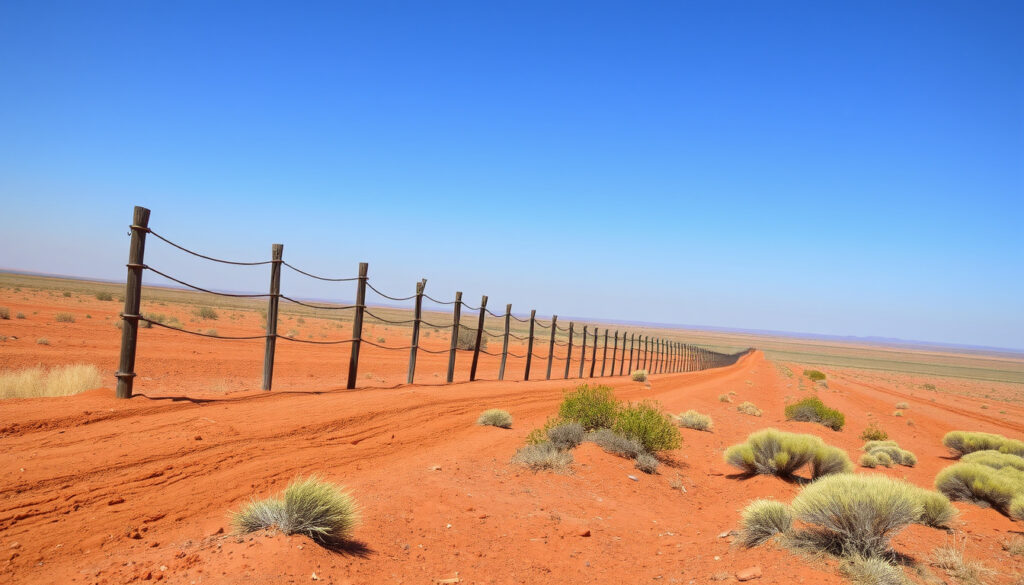
Every great fence tells two stories: one of what it kept out, and another of what it held together. The Rabbit-Proof Fence in Western Australia stretches 1,833 km across the outback, yet its most famous journey wasn’t made by rabbits—it was made by three Aboriginal girls who followed it home in 1931.
Total length of No. 1 fence: 1,833 km (1,139 mi) (State Library WA) ·
Number of fences: 3 (No. 1, No. 2, No. 3) (Stuff You Missed in History Class) ·
Construction started: 1901 (State Library WA) ·
Distance walked by the girls: Approximately 1,600 km (Wikipedia)
Quick snapshot
- A 1,833 km barrier fence in Western Australia built to stop rabbits (State Library WA)
- Constructed 1901–1907; three separate fence lines (Stuff You Missed in History Class)
- Now a heritage-listed structure (State Library WA)
- Based on Doris Pilkington’s book Follow the Rabbit-Proof Fence (Wikipedia)
- Chronicles the escape of three Aboriginal girls from a mission in 1931 (Wikipedia)
- The girls walked home along the fence line (Wikipedia)
- Film directed by Phillip Noyce, released 2002 (Wikipedia) ((Book review blog))
- Starring Everlyn Sampi, Tianna Sansbury, Kenneth Branagh (Wikipedia) ((Book review blog))
- Doris Pilkington is Molly’s daughter (Book review blog)
- Symbol of the Stolen Generations and Indigenous resilience (State Library WA)
- Tourist attraction with interpretive sites (State Library WA)
- Still referred to as Rabbit-Proof Fence in popular culture (Wikipedia)
Eight key facts, one pattern: the fence’s official identity vs. its cultural meaning.
| Attribute | Detail | Source |
|---|---|---|
| Official name | State Barrier Fence of Western Australia | State Library WA |
| Construction period | 1901–1907 | State Library WA |
| Total length (No. 1 fence) | 1,833 km (1,139 mi) | State Library WA |
| Purpose | Prevent rabbits from entering agricultural land | State Library WA |
| Current status | Partially maintained; heritage listed | State Library WA |
| Movie release | 2002 | Wikipedia |
| Book author | Doris Pilkington | Wikipedia |
| Girls’ names | Molly Craig, Daisy Kadibil, Gracie Fields | Wikipedia |
What was the Rabbit-Proof Fence?
Purpose and construction
The Rabbit-Proof Fence was a series of barrier fences built in Western Australia between 1901 and 1907 to stop rabbits from spreading into agricultural areas (State Library WA). The No. 1 fence, the longest, stretches 1,833 km from the northwest coast near Port Hedland to the southern coast at Starvation Bay (State Library WA). Construction was a massive undertaking, with teams setting thousands of posts and miles of wire across harsh terrain.
History of rabbit infestations in Australia
Rabbits were introduced to Australia for hunting in 1859 and spread explosively (Stuff You Missed in History Class). By the 1880s, states had started building rabbit-control fences (Stuff You Missed in History Class). Western Australia, isolated by desert, hoped to keep its agricultural regions rabbit-free.
The three fence lines: No. 1, No. 2, No. 3
The fence consisted of three separate fences: No. 1 (the longest), No. 2 built in 1905 to cover a gap, and No. 3 farther east (State Library WA). Together they formed a 2,000+ km barrier system designed to block rabbits’ westward march.
A structure built to exclude pests later became a lifeline for three girls fleeing a system that wanted to exclude them from their own culture. The fence’s dual identity is at the heart of its lasting power.
Bottom line: The Rabbit-Proof Fence was a bold agricultural project that used steel and wire to fight an ecological invasion—but its most famous chapter was written by human feet, not rabbit paws.
Does the Rabbit-Proof Fence work?
Initial effectiveness and rabbit-proof design
The fence did slow the westward spread of rabbits for a time (State Library WA). The design—wire netting buried at the base—was meant to stop burrowing. However, rabbits had already been found west of the fence line by 1902, just a year after construction began (State Library WA).
Why the fence ultimately failed
By the 1920s, rabbits had crossed the fence in many places, and it became less effective (Stuff You Missed in History Class). Rabbits dug under gaps, found holes, and bred faster than repairs could keep up. The fence was a barrier, not a wall.
Modern remnants and maintenance
Today, the fence is no longer maintained for rabbit control, but parts still stand as heritage structures (State Library WA). Work on the State Barrier Fence began in 1901 and it is still maintained today as a livestock barrier (Stuff You Missed in History Class).
Bottom line: The fence bought Western Australia a few decades of partial protection from rabbits, but the biology of a breeding species overwhelmed the engineering. Its modern role is as a cultural artifact and livestock boundary, not a rabbit-proof shield.
What is the Rabbit-Proof Fence called today?
Current official name: State Barrier Fence of Western Australia
Officially known as the State Barrier Fence of Western Australia, it is also called the Rabbit-Proof Fence due to its original purpose (State Library WA). The dual name reflects its hybrid identity: an active agricultural structure and a historical landmark.
Role as a cultural landmark
The fence is a heritage-listed site and appears on maps as a historical feature (State Library WA). The State Library of Western Australia notes that the fence “has become synonymous in recent years with the Stolen Generation through the 2002 film” (State Library WA).
Tourist sites along the fence
Sections of the fence are accessible to visitors, with interpretive signage (State Library WA). Travelers can follow parts of the fence line near Jigalong and other outback towns, though many remote sections remain unmarked.
For tourists planning to visit, exact location data for some fence sections may not be publicly marked, and conditions in remote Western Australia require careful preparation.
The fence’s name today reflects its layered history: a practical barrier that became a symbol of resilience.
What is the message in Rabbit-Proof Fence?
Themes of the movie and book
The story highlights the forced removal of Aboriginal children from their families, part of the Stolen Generations (Wikipedia). The fence becomes a guide—a physical thread leading home. Director Phillip Noyce described the film as a way to tell the story of the Stolen Generations “through the eyes of the children” (Wikipedia).
Connection to the Stolen Generations
The phrase “Stolen Generations” refers to Aboriginal children taken from their families under official child-removal policy in Australia, which existed approximately between 1905 and 1967 (Wikipedia). The policy targeted mixed-descent children—then called “half-castes”—with the goal of assimilation and ultimately “breeding out” Aboriginal culture (YouTube explainer video, low confidence).
Resilience and survival
The journey of Molly, Daisy, and Gracie symbolizes resistance and the deep connection to land and family (Wikipedia). The film does not shy away from the brutality of the policy, but it centers the girls’ courage.
The message criticizes government assimilation policies while celebrating Indigenous strength. It asks viewers to hold two truths: the fence was a tool of colonial agriculture, and it was also a road home.
The dual legacy of the fence continues to shape Australian conversations about reconciliation.
Did Molly and Daisy ever see Gracie again?
The real story of the three girls
Molly Craig, Daisy Kadibil, and Gracie Fields were taken from their families in Jigalong in 1931 and sent to the Moore River Native Settlement (Wikipedia). They escaped and walked roughly 1,600 km home over nine weeks, following the Rabbit-Proof Fence as a navigational aid (Wikipedia).
What happened after their journey
Molly and Daisy completed the walk back to Jigalong, but Gracie was recaptured and taken to a different institution (Wikipedia). Molly later married and had a daughter, Annabelle, who was also taken away (Book review blog).
Gracie’s capture and later life
Molly and Daisy never saw Gracie again after they parted ways during the escape (Wikipedia). Gracie’s later life remains less documented than Molly’s, but her story is a reminder of how many Stolen Generations children were permanently separated from their families.
Bottom line: The escape was a partial success: two girls made it home, but Gracie was not among them. The reunion that never happened underscores the policy’s cruel logic of separation.
Timeline
Seven milestones track the fence from rabbits to resilience.
| Date/Period | Event | Source |
|---|---|---|
| 1859 | Rabbits introduced to Australia for hunting; rapid spread. | Stuff You Missed in History Class |
| 1901–1907 | Construction of the Rabbit-Proof Fence (No. 1, No. 2, No. 3) in Western Australia. | State Library WA |
| 1931 | Molly, Daisy, and Gracie escape from the Moore River Native Settlement and walk home along the fence. | Wikipedia |
| 1930s–1940s | Fence effectiveness declines; rabbits eventually cross despite efforts. | Stuff You Missed in History Class |
| 1996 | Doris Pilkington publishes Follow the Rabbit-Proof Fence. | Wikipedia |
| 2002 | Film Rabbit-Proof Fence released, directed by Phillip Noyce. | Wikipedia |
| 2020s | Fence sections remain as heritage sites; ongoing tourism and education. | State Library WA |
Clarity: Confirmed Facts vs. What’s Unclear
Confirmed facts
- The fence was built to stop rabbit spread in Western Australia. (State Library WA)
- The three girls walked approximately 1,600 km to return home. (Wikipedia)
- Gracie was recaptured and did not reunite with Molly and Daisy. (Wikipedia)
What’s unclear
- Exact location of some fence sections may not be publicly marked. (State Library WA)
- Whether the fence ever fully achieved its rabbit-control goals is debated; some say it only delayed the spread. (State Library WA)
- The precise route taken by the girls differs slightly from the film’s depiction. (Wikipedia)
- Molly Craig’s daughter Annabelle was also taken and eventually wrote about it, but details of her later life are less documented. (Book review blog)
- The true number of children removed under Stolen Generations policy is uncertain, with estimates ranging from 35,000 to higher. (YouTube explainer video, low confidence)
Perspectives on the Rabbit-Proof Fence
The Rabbit-Proof Fence has become synonymous in recent years with the Stolen Generation through the 2002 film.
— State Library of Western Australia (official heritage institution) (source)
I wanted to tell the story of the Stolen Generations through the eyes of the children.
— Phillip Noyce, film director (Wikipedia)
Molly was known as a ‘half-caste,’ the daughter of an Aboriginal woman and a white man—precisely the kind of child the policy targeted for removal.
— Book review blog (analysis of Doris Pilkington’s biography) (source)
The fence was our guide.
— Molly Craig (as recorded in oral history, cited in the film’s production notes) (Wikipedia)
The pattern: The fence—an agricultural structure—became a symbol of survival, but its original purpose remains largely forgotten outside Western Australia. For Australians, the Rabbit-Proof Fence stands as a dual legacy: a reminder of agricultural ingenuity and a symbol of the ongoing need for reconciliation. For travelers and history enthusiasts, the choice is clear: visit the fence to see its physical scale, but leave with an understanding of the human journey it guided.
Related reading: A Thousand Blows: True Story, Season 2 & Where to Watch
For a detailed account of the girls’ journey and the historical context, you can read the full story of the Rabbit-Proof Fence from an Australian perspective.
Frequently asked questions
Is the Rabbit-Proof Fence a true story?
Yes, the 2002 film is based on the real escape of Molly Craig, Daisy Kadibil, and Gracie Fields from the Moore River Native Settlement in 1931 (Wikipedia).
How long did it take Molly, Daisy, and Gracie to walk home?
They walked for about nine weeks, covering approximately 1,600 km along the Rabbit-Proof Fence (Wikipedia).
Can I visit the Rabbit-Proof Fence today?
Yes, sections of the fence are accessible, particularly near Jigalong and along the No. 1 fence line. It’s a heritage site with interpretive signage in some areas (State Library WA).
What happened to Molly Craig after the walk?
Molly returned to Jigalong, later married, and had a daughter named Annabelle, who was also taken under the Stolen Generations policy. Annabelle’s daughter Doris Pilkington wrote the book Follow the Rabbit-Proof Fence (Book review blog).
Why was the fence called Rabbit-Proof?
The name comes from its original purpose: a barrier designed to be impenetrable to rabbits, using wire netting buried at the base (State Library WA).
Are there multiple Rabbit-Proof Fences?
Yes, there were three fences built: No. 1 (the longest at 1,833 km), No. 2 (built in 1905), and No. 3 (further east) (State Library WA).
What is the No. 1 Rabbit-Proof Fence?
The No. 1 Fence is the longest and best-known barrier, stretching from Port Hedland on the northwest coast to Starvation Bay on the southern coast (State Library WA).
How can I watch Rabbit-Proof Fence online?
The film is available on several streaming platforms (check current listings on services like Apple TV, Amazon Prime, or Kanopy) (Wikipedia).
More related posts
 GTA San Andreas in 2025: Still Worth Playing
 Rita Hayworth: Biography, Death Cause & Ethnicity Facts
 Black Blazer Guide: Best Men’s & Women’s Blazers for 2025
 John Ratzenberger: Pixar’s Good Luck Charm and Voice Roles
 Eija Skarsgård: Casting Director, Age, Siblings, Husband
 Agnetha Fältskog: Biography, Net Worth, and Life After ABBA
 High Modality Words – Definition, Examples and Usage Guide
 Brendan Fraser: Health, Downfall and Oscar Comeback
