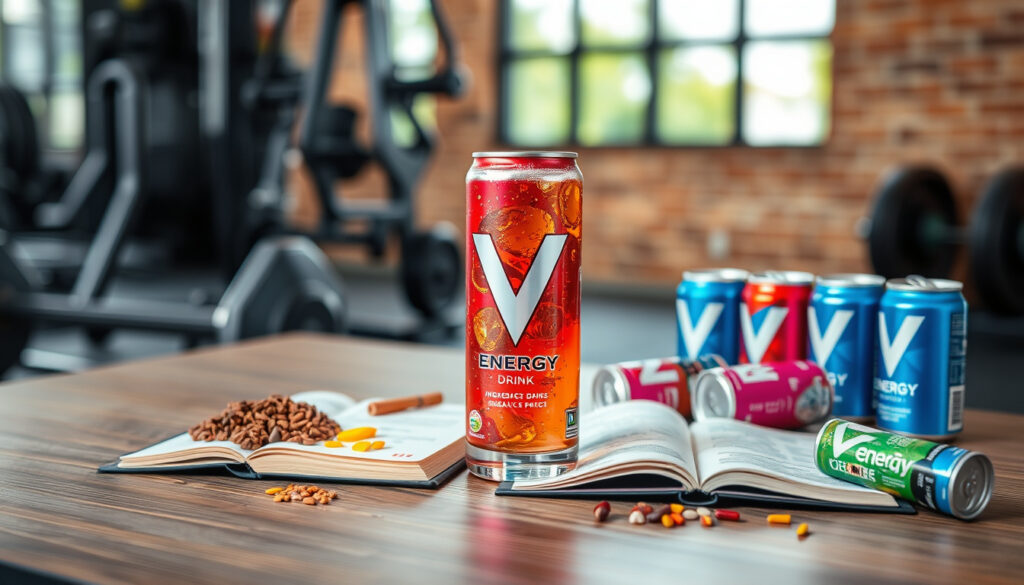
V Energy Drink Guide: History, Ingredients, Health
There’s a reason energy drinks line the shelves of convenience stores from Sydney to London — but not many are as polarizing as V Energy Drink. Born in New Zealand in the late 1990s, this black can has become a staple in Australia and beyond, yet many outside those markets have never heard of it.
Brand owner: Suntory Oceania ·
Introduced in Australia: 1999 ·
Countries available: Australia, New Zealand, United Kingdom, and select others
Quick snapshot
- Owned by Suntory Oceania, a subsidiary of Suntory Holdings (Wikipedia)
- Launched in Australia in 1999 (Wikipedia)
- Contains guarana, caffeine, B vitamins, and taurine (Caffeine Informer)
- Exact caffeine content varies by flavor and market (Australian Institute of Sport)
- Whether V is formally classified among the unhealthiest energy drinks is disputed (Caffeine Informer)
- 1997: V launched in New Zealand (Wikipedia)
- 1999: Entered Australian market (Caffeine Informer)
- 2009: Frucor acquired by Suntory (Wikipedia)
- Expansion into US market remains uncertain; no wide retail distribution (V Energy Drink FAQ)
- Online imports available but at higher cost (V Energy Drink FAQ)
Six key facts about V Energy Drink, from its launch year to its primary ingredients.
| Fact | Detail |
|---|---|
| Year introduced (Australia) | 1999 (Wikipedia) |
| Parent company | Suntory Oceania (Wikipedia) |
| Original producer | Frucor (New Zealand) (Caffeine Informer) |
| Key ingredient | Guarana (Caffeine Informer) |
| Caffeine (per 250 mL) | 78 mg (Australian Institute of Sport) |
| Market share NZ (2000) | Reportedly over 60% (Wikipedia) |
What is the unhealthiest energy drink in the world?
When discussions turn to the most concerning energy drinks, brands like Bang, Reign, Monster, and Rockstar often top the list. V Energy Drink is frequently mentioned in such rankings, though it rarely sits at the very top. The consensus among nutrition-focused outlets is that V’s combination of sugar (about 27 g per 250 mL) and caffeine (78 mg per 250 mL according to the Australian Institute of Sport (national sports nutrition body)) places it in a moderate risk category compared to higher-caffeine formulations.
What are the top 10 worst energy drinks for you?
- Bang Energy – high caffeine (300 mg per can) (Caffeine Informer (energy drink database))
- Reign Total Body Fuel – 300 mg caffeine per can
- Monster Energy – 160 mg per 500 mL (Australian Institute of Sport)
- Rockstar – 160 mg per 473 mL
- V Energy Drink – 78 mg per 250 mL (moderate caffeine, high sugar)
- Full Throttle – 200 mg per 473 mL
- NOS – 260 mg per 680 mL
- AMP Energy – 142 mg per 473 mL
- 5-hour Energy – 200 mg per 57 mL shot
- Red Bull – 80 mg per 250 mL (Australian Institute of Sport)
The implication: V sits in a moderate risk bracket, not at the extreme end.
Is V energy drink sold in the USA?
V Energy Drink is not distributed through mainstream US retail channels. However, it can be purchased online via importers and specialist stores. The brand’s parent company, Suntory Oceania (beverage manufacturer), has not announced plans for widespread US distribution.
Which countries have V energy drinks?
V is primarily available in Australia, New Zealand, and the United Kingdom. It also appears in select Commonwealth nations and through online retailers globally. The official V Energy Drink FAQ (brand site) states that availability varies by market.
What country does V energy come from?
V originates from New Zealand. It was first launched in Methven, New Zealand in August 1997 by the Frucor Company (New Zealand beverage producer). It entered the Australian market in 1999.
The catch: Online imports come at a premium and with variable shipping times.
Who is V energy owned by?
V Energy Drink is owned by Suntory Oceania, a subsidiary of the Japanese conglomerate Suntory Holdings (global beverage giant). The brand was originally developed by Frucor, a New Zealand beverage company, before Suntory’s acquisition of Frucor in 2009 formed what is now Suntory Oceania.
For consumers evaluating brand trust, V’s ownership by a major international conglomerate means the product benefits from substantial R&D and distribution resources, but also that purchasing decisions are tied to corporate sustainability and sourcing policies.
The pattern: Corporate ownership provides stability but also links consumption to broader corporate practices.
What came first, V or Red Bull?
Red Bull holds the title as the pioneer of the modern energy drink category, launched in Austria in 1987. V Energy Drink followed over a decade later, debuting in New Zealand in 1997 and then Australia in 1999. Both brands have since become household names in their respective markets.
A caffeine comparison based on data from the Australian Institute of Sport (government sports nutrition authority) shows they are nearly identical per 250 mL, but V offers slightly less caffeine at 78 mg versus Red Bull’s 80 mg. The trade-off: V typically contains about 27 g of sugar per 250 mL, similar to Red Bull’s 26 g.
Five popular caffeine sources, one pattern: V’s caffeine falls between instant coffee and brewed coffee in intensity.
| Beverage | Caffeine per 250 mL (mg) | Source |
|---|---|---|
| V Energy Drink | 78 | Australian Institute of Sport |
| Red Bull | 80 | Australian Institute of Sport |
| Monster Energy (500 mL) | 160 | Australian Institute of Sport |
| Instant coffee | 60 (range 12–169) | Australian Institute of Sport |
| Brewed coffee | 80 (range 40–110) | Australian Institute of Sport |
What this means: Per milligram, V is comparable to a standard coffee, but the added sugar is the distinguishing health factor.
What are the 7 worst drinks for your gut?
Health experts often flag sugary and artificially sweetened beverages as harmful to the gut microbiome. Energy drinks like V, which combine high sugar (27 g per 250 mL) and caffeine, may increase intestinal permeability and inflammation, according to emerging research.
How does V energy drink affect gut health?
The V Energy Drink FAQ (brand site) states that caffeine in energy drinks is strictly regulated by Food Standards Australia New Zealand. However, the high sugar content remains a concern for long-term gut health. The Australian Institute of Sport notes that energy drinks must declare caffeine content on labels, allowing consumers to make informed choices.
While V’s caffeine is within regulated limits, the sugar load per can (about 6.75 teaspoons) can disrupt gut flora and promote insulin spikes, especially when consumed regularly.
The consequence: Regular consumption may outweigh the benefits of its moderate caffeine content.
Timeline: V Energy Drink history
- 1987: Red Bull launched in Austria, creating the modern energy drink market
- 1997: V Energy Drink launched in Methven, New Zealand by Frucor (Wikipedia)
- 1999: V enters the Australian market (Caffeine Informer)
- 2009: Frucor acquired by Suntory, forming Suntory Oceania (Wikipedia)
- Present: V available in select international markets; limited US presence
The pattern: V’s timeline mirrors the rise of energy drinks in Oceania, with a clear acceleration after corporate acquisition.
What we know vs. what’s uncertain
Confirmed facts
- V is owned by Suntory Oceania (Wikipedia)
- It was launched in Australia in 1999 (Caffeine Informer)
- It contains guarana, caffeine, B vitamins, and taurine (Caffeine Informer)
- Australian regulations limit caffeine in energy drinks to 320 mg/L (Australian Institute of Sport)
What’s unclear
- Exact caffeine content per can may vary by flavor and market (Australian Institute of Sport)
- Whether V is formally classified among the unhealthiest energy drinks (no consensus) (Caffeine Informer)
- Market share data from 2000 (reportedly 60% NZ, 42% Australia) lacks modern verification (Scribd (user-uploaded document))
The takeaway: While core facts are solid, some historical and comparative data remain unconfirmed.
Voices on V Energy Drink
“V Energy, our flagship brand, is packed with delicious flavours and a revitalising kick.”
“V is an energy drink brand produced by Suntory Oceania, a New Zealand–based beverage manufacturer.”
— Wikipedia (user-contributed encyclopedia)
“V has been described as the most popular energy drink in New Zealand.”
— Caffeine Informer (energy drink database)
For Australian consumers watching their caffeine intake, the choice between V and coffee is clear: one 500 ml can of V delivers about 155 mg of caffeine — more than two cups of instant coffee but less than a double espresso. The trade-off is the added sugar and artificial ingredients. For health-conscious buyers in the US hoping to try V through online imports, the cost and regulatory unknowns may outweigh the novelty.
Frequently asked questions
What is the caffeine content of V Energy Drink?
According to the Australian Institute of Sport, V contains 78 mg of caffeine per 250 mL (109 mg per 340 mL, 155 mg per 500 mL).
How many calories are in V Energy Drink?
A standard 250 mL can of V Energy Drink contains approximately 107 calories (448 kJ), primarily from sugar.
Is V Energy Drink vegan?
The V Energy Drink FAQ does not explicitly state vegan status, but the ingredients (caffeine, taurine, guarana) are generally plant-based or synthetic.
Does V Energy Drink contain taurine?
Yes, taurine is listed among the ingredients (Caffeine Informer).
Where can I buy V Energy Drink in bulk?
Bulk purchases are available through online retailers such as Amazon (international shipping) and specialty importers. Prices vary by region.
What flavors does V Energy Drink come in?
V offers a range of flavors including original, sugar-free, blue, green, and limited editions. The official brand site lists current offerings.
Is V Energy Drink worse than Monster?
Per 250 mL, V has 78 mg caffeine and about 27 g sugar; Monster has 80 mg caffeine per 250 mL (160 mg per 500 mL) and 27 g sugar per 250 mL. Both are similar in sugar, but Monster’s higher total caffeine per can makes it a stronger stimulant (Australian Institute of Sport).
More related posts
 Taylor Zakhar Perez – Age, Height, Girlfriend, Movies, Ethnicity
 Ounce to Ml – Precise US and UK Conversion Tables
 A Thousand Blows: True Story, Season 2 & Where to Watch
 JBL Xtreme 4 Review: Battery Life, Loudness & Value
 Sam Mitchell: EastEnders Character vs AFL Coach Guide
 Eva Green: Biography, Marriage, Dispute, and Career
 Mel to Syd – Fastest, Cheapest Ways 2025
 BOM Brisbane Forecast: 7-Day, Hourly, Radar & More
