When Is Daylight Savings – 2024 & 2025 Dates and Rules
Twice annually, millions of Americans adjust their clocks to observe Daylight Saving Time, shifting evening daylight from morning hours during warmer months. Understanding the precise schedule prevents missed appointments and disrupted sleep patterns.
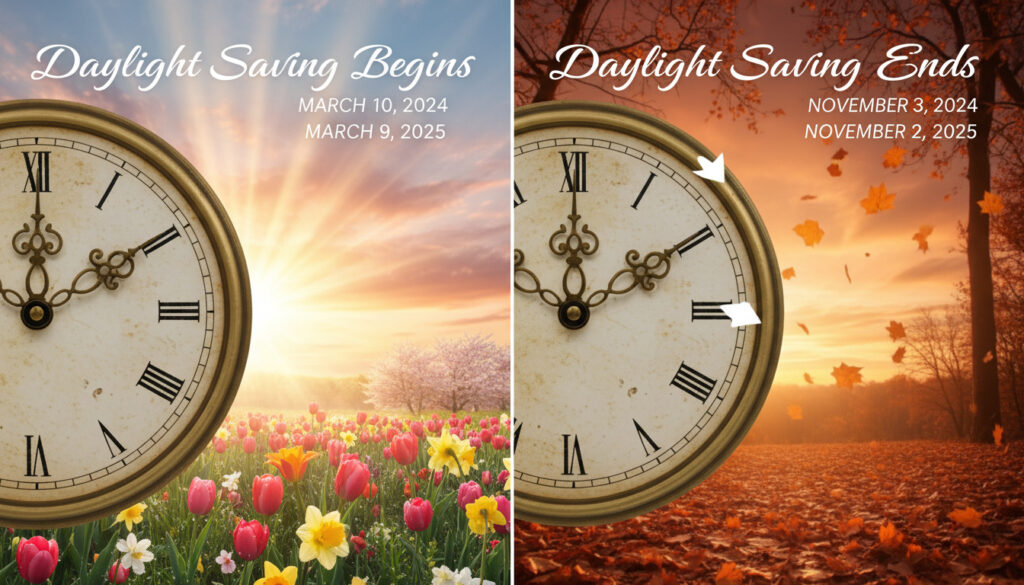
The current federal framework, established by the Energy Policy Act of 2005, mandates specific dates for these transitions. For 2024, the period began on March 10 and concludes on November 3, while 2025 observers will spring forward on March 9 and fall back on November 2.
This guide provides exact dates, clock-change mechanics, and geographical exceptions based on official federal documentation.
When Does Daylight Saving Time Start and End?
2nd Sunday in March
1st Sunday in November
2:00 a.m. local time
2:00 a.m. local time
- Annual Cycle: DST repeats every year on the same relative Sundays.
- Extended Season: Since 2007, DST runs approximately four weeks longer than previous schedules.
- Uniform Time: Changes occur at 2:00 a.m. local time to minimize disruption.
- State Exemptions: Hawaii and most of Arizona remain on standard time year-round.
- Territorial Consistency: US territories including Puerto Rico and Guam do not observe DST.
- Legislative Stability: No federal changes to permanent DST are currently enacted.
| Year | DST Begins | DST Ends | Duration |
|---|---|---|---|
| 2024 | March 10 | November 3 | 238 days |
| 2025 | March 9 | November 2 | 238 days |
| 2026 | March 8 | November 1 | 238 days |
| 2027 | March 14 | November 7 | 238 days |
| 2028 | March 12 | November 5 | 238 days |
What Time Do Clocks Change for DST?
Spring Forward Mechanics
On the second Sunday in March, clocks advance from 1:59 a.m. to 3:00 a.m. local time, effectively removing one hour from that day.
Fall Back Mechanics
On the first Sunday in November, clocks retreat from 1:59 a.m. to 1:00 a.m., creating a 25-hour day and restoring the hour previously removed.
The 2:00 a.m. Standard
Federal law specifies 2:00 a.m. as the changeover time because most people are home, few trains operate, bars are typically closed, and the transition completes before early workers or religious services begin.
Analog devices and non-networked appliances require manual adjustment. Smartphones, computers, and networked electronics typically update automatically based on time zone data.
Which Areas Observe Daylight Saving Time?
States That Opt Out
Hawaii and most of Arizona maintain standard time throughout the year. Arizona opted out due to extreme summer heat; additional evening daylight would extend cooling costs rather than reduce energy consumption.
The Navajo Nation Exception
Within Arizona, the Navajo Nation follows DST to maintain temporal consistency across its tribal lands spanning three states. This creates a situation where the Navajo Reservation operates on different time than nearby Phoenix.
Territories Without DST
US territories including Puerto Rico, the US Virgin Islands, American Samoa, Guam, and the Northern Mariana Islands remain on standard time year-round.
Scheduling considerations for television programming, such as The Rookie Season 8 Premiere Date, account for these regional variations in viewership timing.
Does Daylight Saving Time Happen Every Year?
The Annual Cycle
Yes. DST transitions occur every calendar year on the specified Sundays. The schedule repeats consistently: second Sunday in March through first Sunday in November.
Legislative Status
Despite legislative proposals such as the Sunshine Protection Act, no federal law has established permanent DST. Current statute maintains the biannual transition requirement.
The Sunshine Protection Act, which would make DST permanent, has not passed Congress. Therefore, the 2007 Energy Policy Act schedule remains in effect indefinitely.
Each US time zone switches independently at 2:00 a.m. local time, unlike the European Union where changes align simultaneously at 1:00 a.m. Universal Time.
How Has the DST Schedule Evolved?
- 1918: DST first implemented in the US as an energy conservation measure during World War I.
- August 8, 2005: President George W. Bush signs the Energy Policy Act of 2005.
- 2007: Extended DST schedule takes effect, starting three weeks earlier in March and ending one week later in November.
- March 10, 2024: Spring forward date for 2024.
- November 3, 2024: Fall back date for 2024.
- March 9, 2025: Upcoming spring forward for 2025.
- November 2, 2025: Upcoming fall back for 2025.
What Is Definitive—and What Remains Uncertain
| Established Facts | Uncertain or Pending |
|---|---|
| Federal law mandates DST from second Sunday in March to first Sunday in November | Legislation to make DST permanent has not passed |
| Changes occur at 2:00 a.m. local time in each time zone | Future congressional action on timekeeping standards |
| Hawaii and most of Arizona are exempt from DST | State-level movements to adopt permanent standard time |
| US territories do not observe DST | Health impact studies influencing potential policy changes |
Why Does Daylight Saving Time Exist?
DST originated to conserve energy by shifting daylight from morning to evening hours during warmer months. The “spring forward, fall back” convention maximizes evening daylight when energy demand typically peaks. The Samsung Galaxy Watch 8 Classic provides a detailed look at the upcoming Daylight Saving dates for 2024 and 2025.
The current implementation stems from economic and energy policy decisions rather than agricultural needs, as commonly misunderstood. The 2007 extension specifically aimed to reduce national energy consumption through additional weeks of evening daylight.
Official Documentation and Authority
The National Institute of Standards and Technology (NIST) maintains the official atomic clock and provides the legal time standard for US DST transitions.
Daylight Saving Time begins on the second Sunday in March and ends on the first Sunday in November.
— Federal Documentation, citing Energy Policy Act of 2005
At present, Daylight Saving Time in the United States begins at 2:00 a.m. on the second Sunday of March and ends at 2:00 a.m. on the first Sunday of November.
Key Takeaways for the Next Transition
Daylight Saving Time will resume on March 9, 2025, and conclude on November 2, 2025. Residents of Hawaii, most of Arizona, and US territories should disregard these dates, maintaining standard time throughout the year. For precise synchronization, consult time.gov, the official US time resource. International viewers tracking Unforgotten Season 6 Release Dates should note these time differences when calculating broadcast schedules.
Frequently Asked Questions
Why do we have daylight saving time?
DST originated to conserve energy by shifting evening daylight from morning hours during warmer months. The practice aims to reduce evening electricity usage when demand peaks.
When is the next DST change?
As of April 2026, the next change is fall back on November 1, 2026, when clocks return to standard time until March 8, 2027.
Is DST permanent?
No. Despite proposals like the Sunshine Protection Act, no federal legislation has established permanent DST. The biannual transitions remain mandatory under current law.
Do smartphones update automatically?
Most smartphones, computers, and networked devices update automatically based on time zone settings. Manual adjustment is required only for analog clocks and non-connected appliances.
Which way do clocks move in March?
Clocks spring forward one hour in March, effectively losing an hour. In November, they fall back, regaining the hour previously lost.
More related posts
 Zak Crawley: Downfall, Break, Father, Ranking, and More
 Malcolm Douglas: Life and Death of a Crocodile Hunter
 Rachel Zoe: Divorce, Son’s E-Bike Crash & Net Worth
 Savannah Guthrie: Unanswered Questions About Her Life
 Valerie Mahaffey: Emmy Winner Dies at 71 from Cancer
 Sam Docherty: Illness, Wife, Retirement & What He Said
 2026 School Holidays Vic: Term Dates & Holidays Guide
 Sam Backo Death: Cause, Health, Family, Career – Rugby Legend
