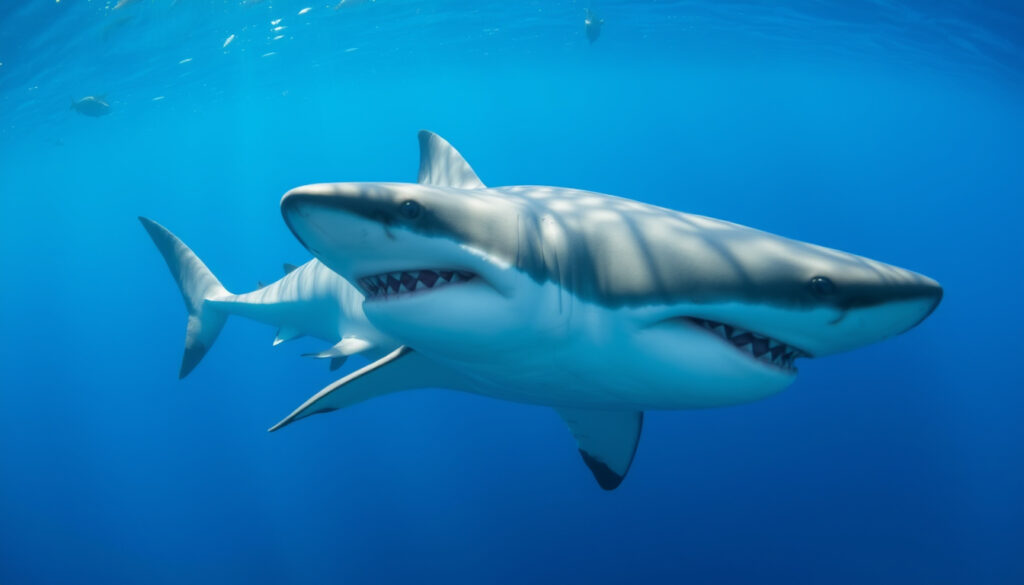
Great White Shark: Facts, Size, Habitat, and Behavior
Few animals command the kind of instinctual respect — and occasional fear — that a great white shark does. But for all the headlines about toothy encounters, the reality is that this 20-foot apex predator has a lot more in common with an ambling ocean traveller than the monster of myth. Over the next few pages, we’ll separate what science actually knows about Carcharodon carcharias — from its real size and lifespan to the awkward truth about who, exactly, eats whom.
Maximum length: 20 feet (6 meters) – females typically larger than males ·
Maximum weight: 4,500 pounds (2,000 kilograms) ·
Number of teeth: Up to 300 serrated teeth arranged in multiple rows ·
Average lifespan: 70+ years in the wild ·
Swimming speed: Up to 25 miles per hour (40 km/h) in bursts
Quick snapshot
- Up to 20 ft long (White Shark Divers (comparison source))
- Coastal temperate waters worldwide (National Geographic (environmental science))
- Seals, sea lions, dolphin carcasses, smaller sharks (NOAA (fisheries research))
- ~30 fatal attacks worldwide per year; most attacks are accidental (University of Florida (shark research))
Confirmed facts
The scientific data on great white sharks reveals a creature of surprising longevity and vulnerability.
| Attribute | Value |
|---|---|
| Scientific name | Carcharodon carcharias (National Geographic (environmental science)) |
| Average length | 11–16 ft (males smaller; females 4.6–4.9 m) (Wikimedia Commons (comparison graphic)) |
| Average weight | 1,500–4,000 lbs (White Shark Divers (comparison data)) |
| Top speed | 25 mph (40 km/h) in bursts (White Shark Divers (speed data)) |
| Lifespan | 70+ years in the wild (National Geographic (environmental science)) |
| Conservation status | Vulnerable (IUCN recognized) |
Are great white sharks in Ireland?
Yes, but not in the way you’d picture — these aren’t Mediterranean vacationers. Occasional sightings off the coast of Ireland do occur, though they are rare and documented in the North Atlantic.
- Great white sharks are occasionally spotted off the coast of Ireland (BBC (regional news coverage))
- They are rare but have been documented in the North Atlantic
- Mediterranean great white sharks belong to a distinct population (Nature (population genetics research))
Great white shark sightings in the Mediterranean
These sharks are not a single wandering group — Mediterranean great whites form a genetically distinct population, one that is smaller and more isolated than their Atlantic cousins.
Are great white sharks common in British waters?
They are not common, but not unheard of. The UK’s waters are colder than what they typically prefer, though occasional sightings off Cornwall and the Irish Sea have been reported.
Are great white sharks aggressive?
This is the question that drives the most clicks — and the most misunderstanding. Let’s check the data.
- Great white sharks are responsible for the most unprovoked attacks on humans (University of Florida (shark attack data))
- Most attacks are exploratory bites, not predation
- Bull sharks and tiger sharks are statistically more dangerous (National Geographic (environmental science))
How often do great white sharks attack humans?
About 30 fatal attacks globally per year — but the vast majority are accidental, not predatory.
Which shark is most likely to eat you?
Statistically, bull sharks and tiger sharks are more likely to be involved in fatal incidents than the great white.
What are the top 3 deadliest sharks?
The list is often debated, but the top three by recorded attacks are: white shark (first), tiger shark (second), and bull shark (third) — per the University of Florida (shark attack data).
The great white’s reputation as a “man-eater” is largely driven by a single film, not by biology. In reality, they are far more curious than predatory.
The pattern: the data consistently shows that great whites are not the deliberate man-eaters popular culture makes them out to be. Their curiosity drives most encounters, and the actual fatality risk is lower than the fear suggests.
What is the only predator of the great white shark?
The answer is surprisingly straightforward: orcas (Orcinus orca). These killer whales are the only known natural predator of adult great whites.
- Killer whales (orcas) are the only known natural predator of adult great white sharks (White Shark Divers (comparison source))
- Orcas have been observed hunting great whites in California and South Africa
- Megalodon is extinct but was larger than the great white
Who would win, 1 orca or 5 great white sharks?
This isn’t a fair fight. Orcas are bigger, faster, and smarter — White Shark Divers (comparison source) notes they weigh 3–10 tons vs the great white’s 1–2 tons.
Great white shark vs megalodon
Megalodon (Otodus megalodon) was about 50–60 feet long — roughly 2.5x larger than today’s great white.
Great White Shark vs Orca: A Detailed Comparison
This table brings together the key measurable differences between the great white shark and its only natural predator.
| Attribute | Great White Shark | Orca |
|---|---|---|
| Average length | 4–5 m (males smaller) (White Shark Divers) | 5–8 m (White Shark Divers) |
| Average weight | 680–1,100 kg (White Shark Divers) | 3,000–10,000 kg (White Shark Divers) |
| Top speed | 40 km/h in bursts (White Shark Divers) | 50–56 km/h in bursts (White Shark Divers) |
| Bite force | up to 18,000 N (White Shark Divers) | Data not available |
| Hunting method | Solitary ambush (White Shark Divers) | Cooperative pod hunting (White Shark Divers) |
| Sociability | Solitary (White Shark Divers) | Pods of up to 40 (2Seewhales) |
What smell do sharks hate?
Sharks have an incredibly sensitive olfactory system — they can detect a drop of blood in 25 gallons of water. But “hate” is not the right word.
- Sharks have a highly sensitive olfactory system (National Geographic (environmental science))
- The smell of dead sharks may repel some species
- No single smell reliably repels great whites in all situations
Do chemical repellents effectively deter sharks?
Some research suggests that the smell of a dead shark can cause a temporary avoidance response, but it is not a reliable deterrent.
What smells attract sharks?
Blood, fish oils, and the scent of injured prey — these are what draw sharks in, not repelling them. If you’re interested in learning more about great white sharks, you can find additional information at Will I Am ADHD Encephalitis.
How big do great white sharks get?
This is the most common question — and the answer varies by sex.
- Average female length 15–16 feet, males 11–13 feet (Wikimedia Commons (comparison graphic))
- Largest verified specimen 21 feet, caught off Cuba
- Weight ranges 1,500–4,000 pounds for mature adults
How much does a great white shark weigh?
Mature adults range from 1,500 to 4,000 pounds — with females typically being the larger sex.
What is the largest great white ever recorded?
The largest verified specimen was 21 feet long, caught off Cuba in 1945 — though some unverified claims go larger.
Related reading: Great White Shark vs Orca · Great White Shark vs Orca comparison
2seewhales.com, ococeanadventures.com, a-z-animals.com, youtube.com
For a deeper dive into the species, check out this comprehensive guide on great white shark facts that separates myth from reality.
Frequently asked questions
Do great white sharks sleep?
They do not sleep in the way humans do. Great whites must keep moving to pass water over their gills — a behavior called ram ventilation.
How long do great white sharks live?
At least 70 years in the wild, with some estimates suggesting up to 100 years — making them one of the longer-lived sharks.
Are great white sharks protected by law?
Yes — they are listed as Vulnerable on the IUCN Red List, and protected in several countries, including Australia and South Africa.
Can great white sharks survive in freshwater?
No — they are strictly saltwater predators. Their kidneys cannot handle the osmotic pressure of freshwater.
Do great white sharks migrate?
Yes — they migrate along continental shelves, often following prey like seals and sea lions.
Why are great white sharks important to the ocean?
They are apex predators that regulate marine ecosystems. Without them, seal populations would explode, disrupting coastal food webs.
What’s unclear
- Exact global population size
- Whether great whites can breed in captivity
- Detailed migratory routes for Pacific populations
“The great white shark is not a man-eater — it is a curious animal that occasionally makes a mistake.”
University of Florida (shark research)
“Orcas are the only animal that can reliably kill an adult great white — and they do it strategically.”
White Shark Divers (comparison source)
For anyone swimming in coastal waters, the real danger is far lower than the headlines suggest. The great white is a predator of opportunity, not of choice — and for the ocean, that choice matters.
More related posts
 GWM Tank 300 – 2026 Prices Specs Hybrid Australia
 Good Guys Osborne Park: Hours, Services, Products & Reviews
 Johnny Silverhand: Complete Character Guide
 Parker Posey: Indie Queen, Personal Life & Lyme Disease
 Pamela Anderson Spouse – 2025 Status and Marriage History
 Eddie Mabo: The Man Behind the Landmark Native Title Decision
 Zak Crawley: Downfall, Break, Father, Ranking, and More
 Kareena Private Hospital – Address Services Contacts
