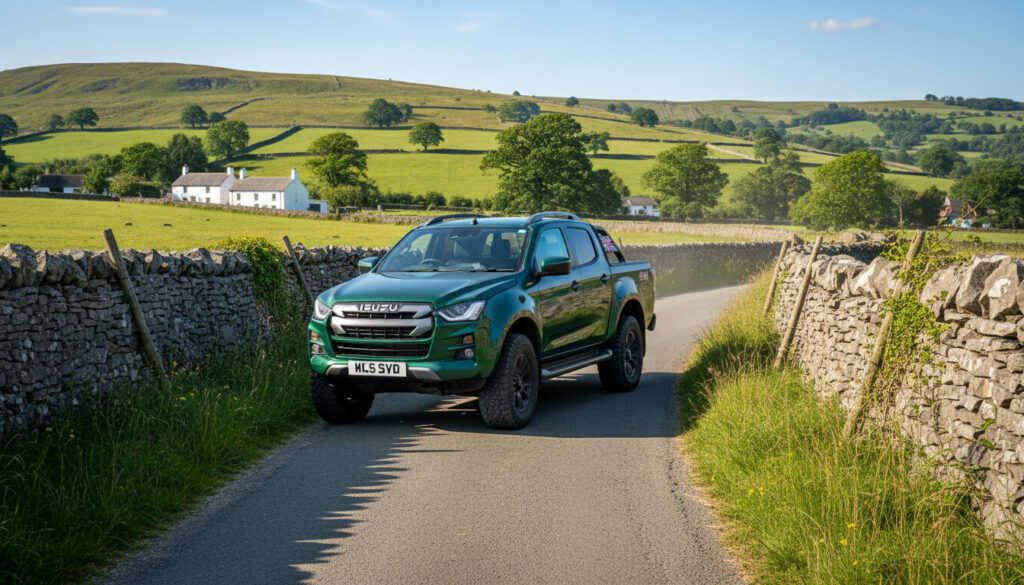
Isuzu D-Max – UK Specs, Prices and Reviews
The Isuzu D-Max occupies a distinctive position within the United Kingdom’s mid-size pickup segment, balancing commercial utility with increasing lifestyle appeal. As the sole model offered by the Japanese manufacturer in Britain, it enters a competitive arena dominated by established rivals including the Toyota Hilux and Ford Ranger, yet distinguishes itself through a combination of competitive pricing and robust mechanical underpinnings.
Since its rejuvenation into the current ‘RG’-series generation, the D-Max has sharpened its aesthetic presentation while retaining the ladder-frame construction and leaf-spring suspension architecture favoured by traditionalists. The range spans from basic Utility specifications intended for fleet operators to the premium V-Cross and Arctic Trucks variants targeting adventure-oriented private buyers, with a fully electric derivative scheduled to join the lineup in 2026.
What is the Isuzu D-Max?
Body Style
Mid-size pickup truck
Generation
RG-series (current)
Key Strength
Durability and safety tech
Market Position
Workhorse to lifestyle
- Sole 1.9-litre diesel engine produces 162bhp and 360Nm of torque
- Class-competitive 3.5-tonne towing capacity across the range
- Unique in UK pickup segment: rear radar fitted as standard on all double cab variants
- Pricing spans from £27,500 (Single Cab Utility) to over £57,000 (Arctic Trucks)
- Sturdy ladder-frame chassis with leaf spring rear suspension
- Six-speed manual or automatic transmission options available
- All-electric variant confirmed for March 2026 deliveries
| Specification | Details |
|---|---|
| Engine | 1.9-litre four-cylinder turbodiesel |
| Power Output | 162bhp |
| Torque | 360Nm |
| Transmission | Six-speed manual or automatic |
| Towing Capacity | 3.5 tonnes |
| Fuel Economy (2WD Manual) | 33.6mpg |
| CO2 Emissions (2WD Manual) | 220g/km |
| Fuel Economy (Auto High-spec) | 31.4mpg |
| CO2 Emissions (Auto High-spec) | 235g/km |
| AdBlue Capacity | 14 litres |
| Acceleration (0-60) | 10.9s (manual) / ~13s (auto) |
| Price Range | £27,500 – £57,000+ |
What are the key Isuzu D-Max specs and performance details?
What engines does the Isuzu D-Max have?
Isuzu offers a single powertrain configuration for the D-Max range. A 1.9-litre four-cylinder turbodiesel engine generates 162bhp and 360Nm of torque, available with either a six-speed manual or automatic gearbox. Auto Express notes that this torque output lags behind key competitors, with the Toyota Hilux delivering between 400Nm and 500Nm depending on specification.
Performance figures reflect this conservative tuning. The manual transmission variant achieves 0-60mph in approximately 10.9 seconds, while the automatic version requires around 13 seconds according to performance testing data.
What is the Isuzu D-Max towing capacity?
The D-Max maintains a 3.5-tonne towing capacity across its range, matching the segment standard for braked trailers. Top Gear confirms this capability is supported by the truck’s properly sturdy ladder frame chassis, though the modest torque output of 360Nm may strain during heavy loads compared with more powerful rivals.
What is the Isuzu D-Max fuel economy?
Fuel efficiency varies by drivetrain configuration. The entry-level Single Cab with two-wheel drive and manual transmission returns 33.6mpg with CO2 emissions of 220g/km. Adding four-wheel drive impacts these figures marginally. High-specification models equipped with the automatic gearbox achieve 31.4mpg with 235g/km CO2 output, according to official WLTP data.
Standard stop-start technology reduces consumption during stationary periods, while a 14-litre AdBlue tank addresses emissions compliance. The filler location adjacent to the fuel tank simplifies replenishment.
Is the Isuzu D-Max good for off-road?
Off-road capability represents a demonstrated strength. The combination of ladder-frame construction and leaf spring rear suspension provides durability over rough terrain. Testing by Auto Express confirms good off-road ability, while the range-topping Arctic Trucks variant offers enhanced “widebody adventure truck” specifications for extreme conditions.
While the 1.9-litre engine provides adequate power for standard operations, the 360Nm torque output is notably lower than the 400-500Nm available from the Toyota Hilux. Buyers prioritising heavy towing or load-lugging in mountainous terrain may find the D-Max requires more frequent gear changes to maintain momentum.
How much does the Isuzu D-Max cost?
The D-Max range encompasses significant price differentiation across six primary configurations. The Single Cab Utility opens the range at approximately £27,500 excluding VAT with standard two-wheel drive. Adding four-wheel drive and a differential lock increases the price by £2,500. The Double Cab Utility variant positions itself around £32,000.
Moving up the hierarchy, the DL20 trim—available in Extended Cab or Double Cab configurations—commands roughly £33,500 excluding VAT, with automatic transmission adding approximately £2,000. The DL40 trim, offered exclusively as a Double Cab, adds around £3,000 to the DL20 price point.
The lifestyle-oriented V-Cross starts just above £38,000, with automatic variants again commanding a £2,000 premium. At the pinnacle sits the Arctic Trucks special edition, priced in excess of £57,000, offering substantial off-road hardware modifications and visual distinction. Top Gear notes this pricing structure undercuts direct rivals significantly.
For buyers comparing value across vehicle categories, the Galaxy A11 to Buy – Best Deals, Prices and Availability offers an interesting contrast in the consumer electronics sector, though the D-Max represents a substantially different investment profile focused on utility and longevity.
Is the Isuzu D-Max reliable and how does it compare?
Isuzu D-Max vs Toyota Hilux
Direct comparison with the Toyota Hilux reveals divergent philosophies. While both vehicles offer 3.5-tonne towing capacities, the Hilux delivers superior torque—between 400Nm and 500Nm depending on specification—against the D-Max’s 360Nm. However, the D-Max counters with competitive pricing and the unique standardisation of rear radar across double cab models.
Ride quality separates the two further. Auto Express identifies the D-Max as lacking the refinement and on-road manners of its Japanese competitor, with a noisier engine under load and less comfortable suspension characteristics.
Is the Isuzu D-Max reliable?
Specific long-term reliability data for the current RG-series generation remains limited in publicly available sources. Isuzu’s reputation for mechanical durability supports expectations of longevity, particularly given the proven ladder-frame construction and the conservative tuning of the 1.9-litre diesel engine. However, comprehensive reliability surveys or owner satisfaction data were not available in the reviewed materials.
Isuzu D-Max safety features
Safety equipment exceeds segment norms in certain respects. The D-Max is distinguished as the only UK pickup featuring rear radar as standard equipment on all double cab variants, enabling advanced driver assistance systems. Exchange and Mart highlights this technology alongside the model’s sharper RG-series styling and smart cabin environment.
Standard stop-start technology and the 14-litre AdBlue system address environmental compliance. However, specific Euro NCAP crash test ratings for the current generation were not provided in available sources, leaving a gap in independently verified safety performance data.
The D-Max occupies a value-oriented position within the UK pickup market. While it lacks the powertrain refinement of the Toyota Hilux, it undercuts most rivals on price while offering unique safety technology through standard rear radar on double cab models.
Independent Euro NCAP crash test ratings for the current RG-series D-Max were not available in the reviewed sources. Buyers prioritising verified safety performance should seek official testing data from the manufacturer or wait for published results.
What is the history and future of the Isuzu D-Max?
Specific historical milestones for the D-Max lineage—including previous generation launch dates or facelift schedules—were not detailed in available sources. The current RG-series represents a rejuvenated form featuring sharper aesthetics and enhanced cabin quality.
- Current Generation (RG-Series): Rejuvenated design with sharper looks and smart cabin features, as noted by Exchange and Mart.
- 2024 Range: Comprehensive trim structure from Utility to Arctic Trucks variants, with pricing from £27,500 to £57,000+.
- March 2026: Planned UK deliveries for the D-Max EV, featuring a 66.9kWh battery, dual motors producing 188bhp and 240lb-ft of torque, and a WLTP range of 163 miles while retaining 3.5-tonne towing and one-tonne payload capabilities, according to Top Gear.
What is confirmed and what remains uncertain about the Isuzu D-Max?
Established Information
- 1.9-litre turbodiesel producing 162bhp and 360Nm
- 3.5-tonne towing capacity standard
- Prices from £27,500 (Single Cab) to £57,000+ (Arctic Trucks)
- Rear radar standard on all double cab variants
- Fuel economy: 31.4-33.6mpg depending on spec
- 14-litre AdBlue tank standard
- D-Max EV confirmed for 2026 with 163-mile range
Uncertain or Unavailable
- Euro NCAP crash test ratings for current generation
- Detailed long-term reliability statistics
- Comprehensive interior feature specifications
- Exact vehicle dimensions
- Full ownership costs (servicing, depreciation)
- Complete historical timeline of previous generations
How does the Isuzu D-Max fit into the current pickup market?
The D-Max occupies a pragmatic niche within an increasingly lifestyle-oriented segment. While rivals like the Ford Ranger and Toyota Hilux emphasise passenger car refinement, the Isuzu maintains commercial vehicle roots evident in its leaf spring rear suspension and steel-wheeled Utility specification. This bifurcation allows it to serve fleet operators requiring basic, durable transport while simultaneously offering the V-Cross and Arctic Trucks variants to private buyers seeking adventure credibility.
The forthcoming electric variant represents a significant strategic pivot, promising to retain core utility attributes—3.5-tonne towing, one-tonne payload, four-wheel drive—while addressing urban emissions restrictions. However, the modest 163-mile WLTP range may limit appeal for rural operators covering significant distances.
The D-Max’s engineering approach prioritises durability over sophistication, distinguishing it from more passenger-car-like alternatives. For readers interested in large-scale transport specifications, the A350-900 – Key Specifications Range Operators provides context on heavy-duty vehicle capabilities, though the D-Max operates in a distinctly different weight class.
What do expert reviews say about the Isuzu D-Max?
“The D-Max is the only pickup in the UK to have a rear radar fitted as standard on all double cab variants, enabling enhanced ADAS functionality.”
— Exchange and Mart
“Competitively priced compared to direct rivals… The Arctic Trucks variant represents a premium ‘widebody adventure truck’ option for serious off-road use.”
— Top Gear
“Strong safety kit and impressive off-road capability, though the underpowered diesel offers insufficient torque for heavy loads compared to class leaders.”
— Auto Express
Is the Isuzu D-Max the right pickup for your needs?
The Isuzu D-Max presents a value proposition centred on mechanical simplicity, competitive pricing, and unique safety technology. It suits buyers prioritising durability and off-road capability over on-road refinement, particularly those seeking a workhorse vehicle with the option of extreme off-road variants. The single engine choice limits powertrain flexibility, and the absence of published Euro NCAP ratings requires consideration, but the standard rear radar and robust construction offer tangible benefits. For operators requiring verified heavy-load performance or car-like ride quality, rivals may prove more suitable, though at a price premium.
Common questions about the Isuzu D-Max
Is there an electric Isuzu D-Max available?
Isuzu has confirmed the D-Max EV for UK deliveries beginning March 2026. It features a 66.9kWh battery with dual motors producing 188bhp, 163 miles of WLTP range, and retains the 3.5-tonne towing capacity.
What is the payload capacity of the Isuzu D-Max?
While specific payload figures for the diesel range were not detailed in available sources, the forthcoming electric variant maintains a one-tonne payload capability alongside its towing capacity.
Does the Isuzu D-Max have a Euro NCAP safety rating?
Specific Euro NCAP crash test ratings for the current RG-series D-Max were not available in the reviewed sources. The vehicle does feature standard rear radar on double cab models.
How does the Isuzu D-Max compare to the Ford Ranger?
Direct comparison data with the Ford Ranger was not available in the reviewed sources. The D-Max is generally priced lower than premium rivals and offers unique rear radar technology.
What is the AdBlue tank capacity?
All D-Max models come with a 14-litre AdBlue tank as standard to meet emissions regulations, with the filler located next to the fuel tank.
Is the Isuzu D-Max comfortable for daily driving?
Expert reviews indicate the D-Max prioritises utility over comfort, with leaf spring suspension and unrefined road manners compared to passenger-car-based rivals.
More related posts
 Big W Pacific Fair: Store Hours, Services & Online Shopping
 Alec Baldwin: Rust Shooting, Charges, and What’s Next
 Mimi Rogers: Age, Net Worth, Marriages, and Tom Cruise Connection
 BBC Football Scores: Live Scores, Results & Fixtures
 David Morse: Biography, Career, Net Worth, and Current Projects
 All Ord Chart: Live Data, Hi torical Performance & Key Fact
 Batman (1989 Film): Cast, Plot, Tim Burton Direction
 Vince Colosimo: Legal Troubles and Life Story
