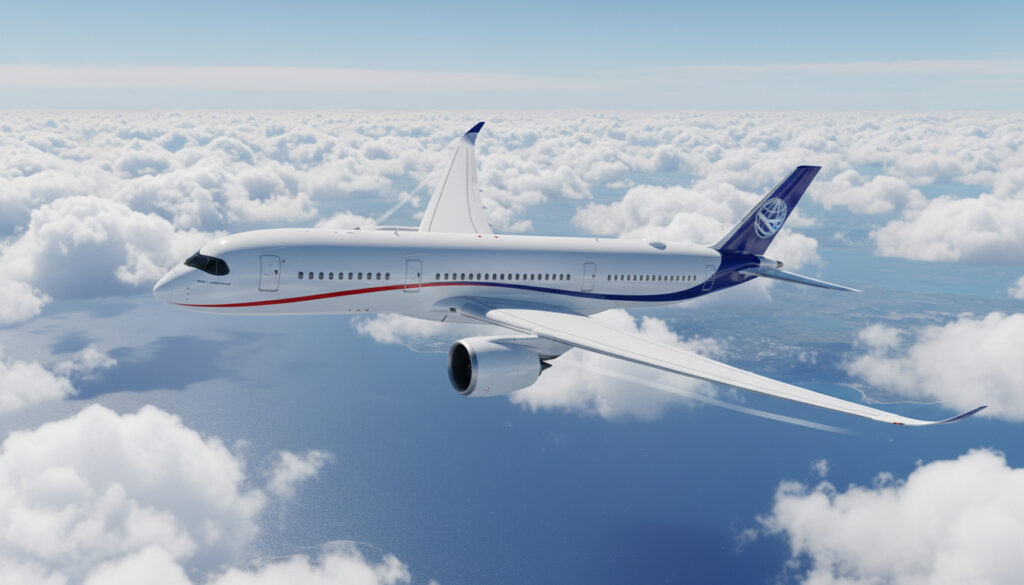
A350-900 – Key Specifications Range Operators
The Airbus A350-900 represents a significant advancement in wide-body commercial aviation, combining extended range capabilities with substantial fuel efficiency improvements. As the cornerstone of Airbus’s modern long-haul fleet, this twin-engine aircraft serves routes exceeding 15,000 kilometers while accommodating between 300 and 440 passengers depending on operator configuration.
Developed to challenge Boeing’s dominance in the long-range market, the A350-900 entered commercial service in 2015 following extensive certification by European and American aviation authorities. Its construction incorporates over 70% advanced composite materials and next-generation powerplants designed to reduce environmental impact while maintaining dispatch reliability above 99%.
Airlines including Qatar Airways, Delta Air Lines, and Japan Airlines currently operate the type on intercontinental services, benefiting from operating costs roughly one-quarter lower than those of previous generation aircraft. The model also serves as the foundation for the Ultra Long Range variant capable of connecting Singapore with the United States without refueling.
What are the key specifications of the Airbus A350-900?
Up to 9,700 nm (18,000 km)
300-440 passengers
Rolls-Royce Trent XWB
2015
- 25% reduction in fuel burn compared to previous generation aircraft
- Over 70% of the airframe constructed from advanced materials including carbon fiber
- Dispatch reliability exceeding 99% according to operational data
- Maximum operating speed of Mach 0.89 (950 km/h)
- Typical cruise speed of Mach 0.85 (903 km/h)
- Operational ceiling of 43,100 feet (13,100 meters)
| Specification | Value | Unit |
|---|---|---|
| Overall Length | 66.8 | meters |
| Wingspan | 64.75 | meters |
| Height | 17.05 | meters |
| Max Takeoff Weight | 280-283 | tonnes |
| Max Fuel Capacity | 166,488 | litres |
| Engines (2x) | Rolls-Royce Trent XWB | 84,000 lbf thrust |
| Typical 3-Class Capacity | 300-352 | seats |
| Maximum Capacity | 440 | seats |
When did the A350-900 enter service and what is its history?
Airbus launched the A350 program in 2006 to address market demand for a more efficient long-range twinjet, positioning the aircraft to replace aging wide-bodies while competing with Boeing’s 787 and 777 families. The A350-900 variant, measuring 66.8 meters in length, emerged as the baseline model for the family.
The prototype completed its maiden flight on , initiating a flight test program that gathered performance data across multiple continents. European Aviation Safety Agency certification followed on September 30, 2014, with Federal Aviation Administration approval granted on November 12, 2014, clearing the aircraft for commercial operations in Western markets.
Qatar Airways accepted delivery of the first production aircraft and initiated revenue service in 2015, marking the type’s entry into active commercial duty. Since then, the fleet has accumulated millions of flight hours across diverse operational environments ranging from Arctic routes to tropical high-altitude airports.
Who operates the A350-900 and what variants exist?
Current Operators and Configurations
Qatar Airways served as the launch customer and remains among the largest operators, utilizing the aircraft on routes connecting Doha with North America, Asia, and Oceania. Delta Air Lines configures its A350-900s with 306 seats divided among 32 Delta One suites, 48 Premium Select, 36 Comfort+, and 190 Main cabin seats.
Japan Airlines operates a high-density 369-seat layout for routes between Japan and Europe or North America. Other significant operators include Vietnam Airlines, Finnair, and various carriers across Asia and Europe who value the type’s combination of range and moderate capacity.
The A350-900ULR
The Ultra Long Range variant extends maximum reach to 9,700 nautical miles (18,000 kilometers), currently the longest range available in commercial aviation. This configuration enables non-stop service between Singapore and the United States East Coast, operating with modified fuel systems but retaining the ability to convert back to standard specifications if market conditions change.
The A350-1000
The stretched A350-1000 measures 73.79 meters in length and typically seats between 350 and 410 passengers in three-class layouts. Powered by higher-thrust Trent XWB-97 engines producing 97,000 pounds of force, this variant carries approximately 40 more passengers than the -900 while maintaining comparable range performance.
Telstra Prepaid Recharge – Complete Top-Up Guide
What is the commercial profile of the A350-900?
Fuel Efficiency and Environmental Performance
The A350-900 achieves approximately 25% better fuel efficiency compared to the generation of aircraft it replaces, including the Airbus A340-300 and early Boeing 777 models. This reduction stems primarily from the Rolls-Royce Trent XWB powerplants, widely regarded as the most efficient large civil engines currently in production, combined with the extensive use of carbon fiber composites in the wing and fuselage.
Airlines operating the A350-900 report dispatch reliability exceeding 99%, meaning fewer than one in 100 flights experience technical cancellations. This reliability metric, combined with reduced fuel consumption, translates to lower operating costs per seat-mile than competing wide-bodies of similar capacity.
Economic Considerations and Market Position
The aircraft competes directly with the Boeing 787-9 and 777-200ER, offering airlines a middle ground between the Dreamliner’s efficiency and the triple-seven’s capacity. Its ability to serve 15,000-kilometer routes economically allows carriers to bypass traditional hub-and-spoke systems in favor of direct city pairs previously unviable with smaller aircraft.
Over 70% of the A350-900’s structural weight consists of advanced materials including carbon fiber reinforced plastic, titanium, and aluminum alloys. This composition reduces overall aircraft weight while improving resistance to corrosion and fatigue compared to traditional aluminum construction.
Current list prices and exact order backlogs for 2025 remain unavailable in public disclosures. While Airbus continues production, specific financial figures and remaining delivery commitments have not been released in recent public fact sheets.
What are the key milestones in A350-900 development?
-
2006
Airbus formally launches the A350 program to compete in the long-range wide-body market Source: Airbus Factsheet -
First flight of the A350-900 prototype from Toulouse-Blagnac Airport (Source: Airbus Factsheet) -
European Aviation Safety Agency grants type certification (Source: Airbus Factsheet) -
Federal Aviation Administration issues U.S. certification (Source: Airbus Factsheet) -
2015
Entry into commercial service with Qatar Airways as launch customer (Source: Airbus Aircraft) -
2018
A350-900ULR enters service with Singapore Airlines on Singapore-New York route Source: Axon Aviation -
Present
Continuous production with fleet operations across six continents
What facts are confirmed and what remains unclear?
| Established Information | Uncertain or Unavailable |
|---|---|
| All physical dimensions and weight specifications certified by EASA and FAA | Current list price per unit as of 2025 |
| Exact dates of first flight, certification, and entry into service | Specific number of outstanding firm orders in current backlog |
| Confirmed operators including Qatar Airways, Delta, and Japan Airlines with verified configurations | Precise delivery schedules for remaining orders |
| Fuel efficiency improvements of 25% over previous generation aircraft | Detailed comparative operating costs versus Boeing 787 on identical routes |
How does the A350-900 fit into the modern aviation market?
The A350-900 occupies a strategic position between Boeing’s 787-9 and the larger 777-300ER, offering capacity for approximately 325 passengers with range exceeding either competitor. This positioning allows airlines to replace older four-engine Airbus A340-300s while maintaining similar capacity with significantly reduced fuel consumption.
On routes exceeding 7,000 nautical miles, the aircraft’s economics favor direct services over connections, enabling carriers to open thin long-haul markets previously unsustainable with larger wide-bodies. The type has proven particularly popular among European and Asian flag carriers seeking to replace aging Airbus A330s and early Boeing 777s without increasing per-flight capacity.
Wikipedia’s technical documentation and SKYbrary’s safety database provide additional technical context regarding the aircraft’s systems and operational characteristics.
What sources verify these specifications?
Primary technical data originates from Airbus official documentation including the January 2025 A350 Family Facts and Figures publication. Dimensional specifications and performance parameters appear consistently across Airbus Commercial Aircraft technical pages, Axon Aviation databases, and aviation technical analyses.
Regulatory data derives from EASA type certification records and FAA validation documents. Operator-specific configurations come from official airline fleet pages including Delta Air Lines and Japan Airlines technical specifications. Additional reference materials include Wikipedia’s technical documentation and SKYbrary’s safety database.
What defines the Airbus A350-900?
The Airbus A350-900 establishes itself as a technologically advanced long-range wide-body that balances capacity, range, and operating economics through extensive use of composite materials and efficient propulsion. With certified performance exceeding 9,700 nautical miles and a track record of reliability since 2015, the type serves as a workhorse for international carriers replacing aging four-engine fleets while maintaining the flexibility to serve secondary long-haul markets profitably. Nepali Restaurant Near Me – Erie’s Best Authentic Spots
Common questions about the A350-900
Is the A350-900 still in production?
Yes, Airbus continues manufacturing the A350-900 at its Toulouse facility alongside the larger A350-1000 variant, though specific production rates and delivery schedules for 2025 remain undisclosed.
What is the maximum range of the A350-900ULR?
The Ultra Long Range variant achieves 9,700 nautical miles (18,000 kilometers), enabling non-stop flights from Singapore to the United States East Coast.
How does the A350-900 compare to the Boeing 777X?
The A350-900 carries fewer passengers than the 777-9 but offers comparable range with superior fuel efficiency per seat, while the 777X provides greater total capacity for high-density routes.
Which airlines currently fly the A350-900?
Major operators include Qatar Airways, Delta Air Lines, Japan Airlines, Vietnam Airlines, and Finnair, among others across Europe, Asia, and North America.
How fuel efficient is the A350-900 compared to older aircraft?
The aircraft consumes approximately 25% less fuel than the generation it replaces, including the Airbus A340 and early Boeing 777 models.
What engines power the A350-900?
Two Rolls-Royce Trent XWB engines provide propulsion, each generating 84,000 pounds of thrust with efficiency ratings superior to competing powerplants.
When did the A350-900 first fly?
The prototype completed its maiden flight on June 14, 2013, from Toulouse-Blagnac Airport in France.
More related posts
 Nikolaj Coster-Waldau: Biography, Career, Languages, and Net Worth
 Ant Middleton: Conviction, SAS Exit & Amazing Race Controversy
 BOM Brisbane Forecast: 7-Day, Hourly, Radar & More
 Gypsy Rose Blanchard Net Worth, Baby Father, and Life After Prison
 Willem Duursma: Age, Height, Stats & Family – AFL Profile
 Qantas Frequent Flyer Login: Sign In, Recover & Check Points
 Mimi Rogers: Age, Net Worth, Marriages, and Tom Cruise Connection
 Dennis Waterman: Biography, Cause of Death & Career
