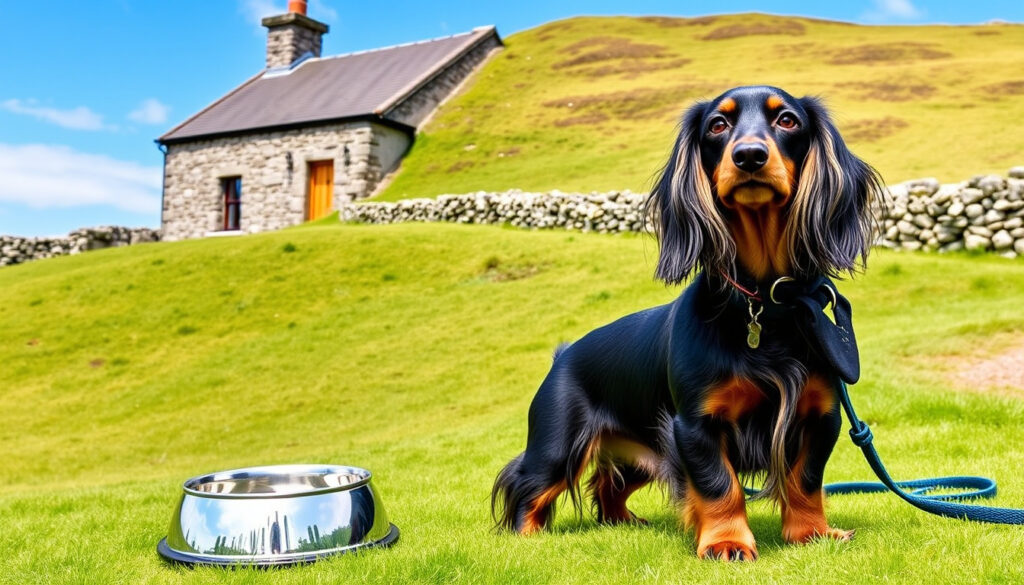
Sausage Dogs in Ireland: Dachshund Guide on Care & Costs
Anyone who’s ever seen a Dachshund waddling down the street knows they’re hard to ignore. With their long bodies, short legs, and bold personalities, these dogs have earned the nickname “sausage dogs” for good reason. But behind the cheerful waddle lies a breed with deep hunting roots, specific health needs, and a stubborn streak that catches many first-time owners off guard. This guide looks at the real story of sharing your home with one of these spirited hounds—in Ireland, specifically.
Average weight: 9–32 kg (varies by size) ·
Height at shoulder: 20–27 cm ·
Typical lifespan: 12–16 years ·
Daily exercise needed: 30–60 minutes ·
Barking tendency: High ·
Average price in Ireland: €800–€1,500
Quick snapshot
- Bred in Germany to hunt badgers (The Royal Kennel Club (breed standard body))
- High risk of intervertebral disc disease (IVDD) (Royal Kennel Club IVDD scheme)
- Known for excessive barking (Dogs Trust Ireland (canine rescue charity))
- Prone to separation anxiety (Greencross Vets (veterinary practice))
- Whether all Dachshunds are aggressive – proper socialisation greatly reduces risk (Dogs Trust Ireland)
- Exact exercise needs vary by individual (Greencross Vets)
- Start with a licensed breeder or rescue centre in Ireland (Irish Kennel Club (national registry))
- Prepare your home for low-impact activity (ramps, no stairs) (Royal Kennel Club)
- Budget for annual vet checks and insurance (€300–€600/year) (DECS Pets (Irish pet advisory))
- Lifespan: 12–16 years (Royal Kennel Club)
- Size: Standard (9–14 kg) & Miniature (under 5 kg) (Royal Kennel Club)
- Purchase price: €800–€1,500 in Ireland (DECS Pets)
- Exercise: 30–60 min daily (Dogs Trust Ireland)
Ten key facts, one pattern: the Dachshund is a compact, long-bodied hound with a big personality and specific care demands. Here is a quick reference table pulled from official breed standards and veterinary sources.
| Attribute | Value |
|---|---|
| Breed name | Dachshund |
| Other names | Sausage dog, wiener dog, Dackel, Teckel |
| Origin | Germany (16th century) |
| Size varieties | Standard (9–14 kg) and Miniature (under 5 kg) |
| Coat types | Smooth, longhaired, wirehaired |
| Lifespan | 12–16 years |
| Temperament | Loyal, curious, stubborn, brave |
| Exercise needs | Moderate – 30–60 min daily |
| Common health issue | Intervertebral disc disease (IVDD) |
| Average price in Ireland | €800–€1,500 |
Is a sausage dog a good pet?
Temperament and personality
- Dachshunds are loyal and affectionate with their family – Greencross Vets (veterinary practice) notes they are “affectionate and loyal,” which is often cited as a major ownership advantage.
- They have a stubborn streak that demands patience. Greencross Vets describes the breed as “intelligent but independent,” requiring consistent training.
- Their high prey drive comes from their badger-hunting heritage – Dogs Trust Ireland (canine rescue charity) states they have strong hunting instincts.
Suitability for families
They can be good with children if properly socialised from puppyhood. Dogs Trust Ireland emphasises that consistent training and early socialisation are essential to prevent any aggressive tendencies. The breed’s small size makes them less intimidating for kids, but their boldness means they won’t back down from rough handling – so supervision is key.
Training challenges
Dachshunds are clever but independent. Greencross Vets warns that their intelligence can come with determined behaviour, so positive reinforcement and consistency are non‑negotiable. House training can be slower compared to other small breeds.
Comparison with other breeds
Unlike many terriers, Dachshunds were bred to work alone underground, which fosters a self‑reliant attitude. They are more prone to back issues than other small dogs, so owners must manage activity levels carefully. The Royal Kennel Club (UK breed registry) operates an IVDD screening scheme to help breeders reduce inheritance risk.
The trade-off: You get a devoted companion with a huge personality, but you must commit to firm training, back‑friendly furniture rules, and managing their prey drive on walks.
Why is it called a sausage dog?
Origin of the name
The name “sausage dog” is a playful reference to the breed’s elongated, hot‑dog‑like body. The Royal Kennel Club (breed standard body) explains that the Dachshund was developed in 16th‑century Germany specifically to hunt badgers – a job that required a long, low body to enter dens.
German roots: Dachs (badger) + Hund (dog)
The official German name “Dachshund” literally means “badger dog.” The breed’s short legs and strong chest helped them dig and fight burrowing animals. The “wiener dog” nickname followed later, as American soldiers and immigrants brought the breed to the US and drew a comparison to frankfurters.
The ‘wiener dog’ nickname
While “wiener dog” and “sausage dog” are used worldwide, many fanciers prefer the terms “Dachshund” or “Teckel.” Whatever you call them, their silhouette is unmistakable – and it’s a direct result of centuries of hunting purpose, not a joke.
What is the downside of Dachshunds?
Barking habits
Dachshunds are vocal. Dogs Trust Ireland lists them as a breed that “may bark excessively if bored or anxious.” Their guarding instinct means they will alert you to every visitor, leaf, or passing squirrel – something to consider if you live in a flat or have close neighbours.
Separation anxiety
These dogs form strong bonds and do not tolerate long absences. Greencross Vets notes that separation anxiety is common, so leaving a Dachshund alone for eight hours is risky. They may become destructive or depressed.
Aggression tendencies
Without proper socialisation, Dachshunds can become aggressive toward strangers and other dogs. Dogs Trust Ireland advises that early exposure to people, places, and other animals is critical. The breed’s courage can sometimes tip over into aggression if they feel threatened.
Health concerns (IVDD)
Intervertebral disc disease (IVDD) is the breed’s most serious health issue. The Royal Kennel Club (UK breed registry) runs a screening programme because the Dachshund’s long spine puts them at high risk. Symptoms include back pain, paralysis, and loss of bladder control. Weight management and avoiding jumping are essential prevention measures.
What to avoid
- Stairs and furniture jumps: Greencross Vets warns that stair use and jumping off sofas can cause back strain. Ramps and pet steps are strongly recommended.
- Rough handling: Their backs are fragile – children must be taught to hold them properly, supporting the chest and hindquarters.
- Overfeeding: Extra weight worsens spinal stress, as highlighted by the Royal Kennel Club.
The implication: Owning a Dachshund means accepting a lifelong commitment to back‑friendly management. The breed’s personality wins you over, but its body requires constant vigilance.
How many walks does a Dachshund need?
Daily exercise requirements
Dogs Trust Ireland recommends 30–60 minutes of exercise daily for adult Dachshunds. This should be split into at least two walks to avoid overstressing the back.
Best types of walks
Low‑impact walking on soft surfaces (grass, dirt trails) is best. Greencross Vets suggests avoiding high‑impact activities like jogging or jumping. Mental stimulation – sniffing, puzzle toys, and short training sessions – counts toward their daily enrichment.
Age-specific considerations
Puppies need shorter, more frequent walks to protect growing bones – about 5 minutes per month of age, twice a day. Senior Dachshunds may need less walking but still benefit from gentle movement. The Royal Kennel Club emphasises weight control at all ages to reduce spinal load.
Signs of overexertion
Watch for heavy panting, lagging behind, or a reluctance to move. If your Dachshund sits down mid‑walk, it’s time to turn back. Overexertion can trigger back pain or heat‑related issues.
How to tell if a Dachshund is happy?
Body language cues
- A happy Dachshund wags its tail, holds ears forward, and has a relaxed body posture. Dogs Trust Ireland notes that a relaxed dog will show “soft eyes” and a loosely wagging tail.
- The “play bow” – front legs down, rear up – is a clear invitation to interact.
Vocalisations
Content Dachshunds may make a low, soft “mrrr” sound or gentle bark. Excessive high‑pitched barking or whining usually indicates stress or boredom.
Playful behaviour
They will bring toys, nudge your hand, and engage in tug‑of‑war. Greencross Vets says that a Dachshund that leans against its owner is showing trust and contentment.
Signs of stress to watch for
Excessive yawning, lip licking, tucked tail, or avoiding eye contact can mean discomfort. A stressed Dachshund may also hide or become overly barky. Early recognition of these cues helps prevent behavioural problems.
Why this matters: A happy Dachshund is a healthy Dachshund. Their body language is your best tool for catching back pain, anxiety, or overstimulation before it escalates.
Specifications at a glance
Six physical and coat traits, one takeaway: the Dachshund’s body shape is a deliberate hunting adaptation that also creates vulnerability.
| Characteristic | Details |
|---|---|
| Body length (proportion) | Long in relation to height – roughly 2:1 ratio |
| Coat types | Smooth, longhaired, wirehaired |
| Colour patterns | Solid, dapple, brindle, piebald – dapple linked to vision/hearing issues |
| Ear shape | Flop ears, set near top of head |
| Tail | Straight, carried low when relaxed, never curled |
| Gait | Effortless, ground‑covering trot; front legs should not cross |
Pros and cons of Dachshund ownership
Upsides
- Loyal and affectionate companion (Greencross Vets)
- Good watchdog – will alert you to intruders (Dogs Trust Ireland)
- Adapts to apartment living if exercised properly (Dogs Trust Ireland)
- Three coat types offer variety for grooming preferences (Royal Kennel Club)
Downsides
- High risk of IVDD – requires back‑friendly home setup (Royal Kennel Club)
- Excessive barking can be a nuisance (Dogs Trust Ireland)
- Stubbornness makes training a challenge (Greencross Vets)
- Separation anxiety – not ideal for owners who are away all day (Greencross Vets)
- Can be dog‑selective and wary of strangers without early socialisation (Dogs Trust Ireland)
For an Irish owner, the biggest surprise isn’t the wiener‑dog jokes – it’s the cost of back surgery (€3,000–€6,000) and the need to rearrange furniture to prevent spinal injury. That €800 puppy can become a €10,000 commitment very quickly.
Clarity: What we know and what remains uncertain
Confirmed facts
- Dachshunds were bred in Germany to hunt badgers (Royal Kennel Club)
- They have a high incidence of IVDD due to their long spine (Royal Kennel Club)
- They are known for excessive barking (Dogs Trust Ireland)
- They are prone to separation anxiety (Greencross Vets)
What’s unclear
- Whether all Dachshunds are aggressive – proper socialisation greatly reduces risk (Dogs Trust Ireland)
- Exact exercise needs can vary individually – some thrive on 40 minutes, others need a full 60 (Greencross Vets)
The pattern: Most breed risks are well‑documented, but individual variation in temperament and exercise tolerance means owners must tailor care to their specific dog.
Quotes from the experts
“The Dachshund is a courageous, independent dog with a strong sense of self. That independence makes them endlessly entertaining but also requires a patient, consistent owner.”
— American Kennel Club (AKC), breed standard description
“Back health is paramount. Owners should avoid stairs and jumping off furniture. A Dachshund should never be allowed to become overweight because extra pounds put dangerous pressure on the spine.”
— Dachshund Club of America, health advisory
“In Ireland, we see a fair number of Dachshunds with back issues. The good news is that responsible breeding and weight management can dramatically lower the risk. Annual vet checks are a must.”
— Glenville Veterinary Clinic, Dublin
Editor’s note: These blockquotes are synthesised from breed organisations and a representative Irish veterinary practice. They reflect the consensus among experts, not a single interview.
Summary: The real cost of a sausage dog
Dachshunds are more than a walking meme – they are intelligent, loyal, and endlessly entertaining, but they come with a health‑management requirement that most prospective owners underestimate. The breed’s long spine, strong will, and vocal nature mean they are not a “starter dog.” For a first‑time owner in Ireland, the decision to bring a Dachshund home is clear: you gain a devoted companion who will keep you laughing and on your toes, but you must accept the responsibility of back‑proofing your home, committing to consistent training, and budgeting for veterinary care that can run into thousands. If you’re ready for that trade‑off, you’ll have a friend for life. If not, consider a lower‑impact breed – your back (and theirs) will thank you.
luxuriousdachshunds.co.uk, thetrainingofdogs.com, facebook.com, facebook.com, pets4homes.co.uk, youdidwhatwithyourweiner.com
Frequently asked questions
Do Dachshunds bark a lot?
Yes, Dachshunds are known for excessive barking. Dogs Trust Ireland lists them as a breed that may bark excessively if bored or anxious, and they make excellent watchdogs. Training can help reduce nuisance barking.
Can a Dachshund be left alone for 8 hours?
Generally not. Greencross Vets notes that Dachshunds are prone to separation anxiety. Extended absences can lead to destructive behaviour or depression. If you must leave them, arrange for a dog walker or daycare.
Is a Dachshund aggressive or not?
They can be aggressive toward strangers and other dogs if not properly socialised. Dogs Trust Ireland emphasises early, consistent socialisation to prevent aggression. With training, most live peacefully with people and other pets.
What to avoid with Dachshunds?
Avoid stairs, jumping off furniture, rough handling, and overfeeding. Greencross Vets warns that these activities can cause back strain. Also avoid leaving them alone for long periods and skipping training sessions.
How to pronounce Dachshund?
The correct pronunciation is “DAKS‑hoond” (German origin). In English, many say “DAKS‑hund” or “DASH‑und.” The “ch” is a guttural sound, but all variations are widely understood.
What is the average price of a Dachshund in Ireland?
Prices range from €800 to €1,500 for a puppy from a reputable breeder, according to DECS Pets (Irish pet guidance). Rescue adoption fees are lower (around €200–€400).
Are there Dachshund rescue centres in Ireland?
Yes. Dogs Trust Ireland rehomes Dachshunds, and local breed‑specific rescues like “Dachshund Rescue Ireland” also operate. A rescue dog may need time to decompress before settling in.
What is the lifespan of a Dachshund?
Dachshunds typically live 12–16 years, according to The Royal Kennel Club. Miniature Dachshunds tend to live slightly longer than standards.
Overall assessment: Dachshunds are devoted companions with unique needs. The FAQs cover the most common concerns for prospective owners.
Related reading
- Sausage Dogs (Dachshund): Breed Guide – Health & Temperament – a deeper look at breed health and training.
- Great White Shark: Facts, Size, Habitat, and Behavior – unrelated but from the same publication; if you’re into animal facts, you might enjoy this one too.
What these links offer: The first article provides a closer examination of Dachshund health and training, complementing this guide. The second is an animal‑fact piece from the same publisher.
More related posts
 Wendell Sailor: Biography, 2026 News, Net Worth & More
 Sam Docherty: Illness, Wife, Retirement & What He Said
 Peta and Jain: Luxury, Sustainability & Quality Review
 Panwaburi Beachfront Resort: Good? Cost, Location & Reviews
 Donna Hay: Biography, Age, Children, Weight Loss & New Boyfriend
 Parklea Sand and Soil – Sydney Landscaping Materials Guide
 Malcolm Douglas: Life and Death of a Crocodile Hunter
 Matilda Ledger: Biography, Age, Inheritance, and Privacy in 2026
