Foghorn Leghorn: Rooster, Catchphrase & Origins
Anyone who grew up watching Looney Tunes cartoons knows that booming Southern drawl before the punchline arrives. Foghorn Leghorn strutted onto screens in 1946 and has been confusing young predators and irritating barnyard dogs ever since.
First appearance: 1946 (Walky Talky Hawky) ·
Species: Leghorn rooster (anthropomorphic) ·
Creator: Robert McKimson ·
Number of cartoons: 29 (1946–1963) ·
Famous catchphrase: I say, I say, I say!
Quick snapshot
- Full name: Foghorn Leghorn (Wikipedia)
- Species: Anthropomorphic Leghorn rooster (Wikipedia)
- First appearance: 1946 (Walky Talky Hawky) (Toonopedia)
- Creator: Robert McKimson (Wikipedia)
- Girlfriend: Miss Prissy
- Antagonists: Henery Hawk, Barnyard Dawg
- Appeared in 29 theatrical shorts (Villains Wiki)
- Slang term “foghorn” linked to loud voice (Villains Wiki)
Here are the key facts about this iconic character:
| Attribute | Value |
|---|---|
| Full Name | Foghorn Leghorn |
| Species | Leghorn rooster (anthropomorphic) (Wikipedia) |
| First Appearance | 1946 – Walky Talky Hawky (Toonopedia) |
| Creator | Robert McKimson (Wikipedia) |
| Voice Actor | Mel Blanc (original) (Wikipedia) |
| Catchphrase | “I say, I say, I say!” (Ranker) |
| Number of Theatrical Shorts | 29 (1946–1963) (Villains Wiki) |
| Girlfriend | Miss Prissy |
The pattern: Foghorn’s core identity is a collision of breed, voice, and radio comedy heritage — a combination that made him instantly recognizable.
What is a Foghorn Leghorn?
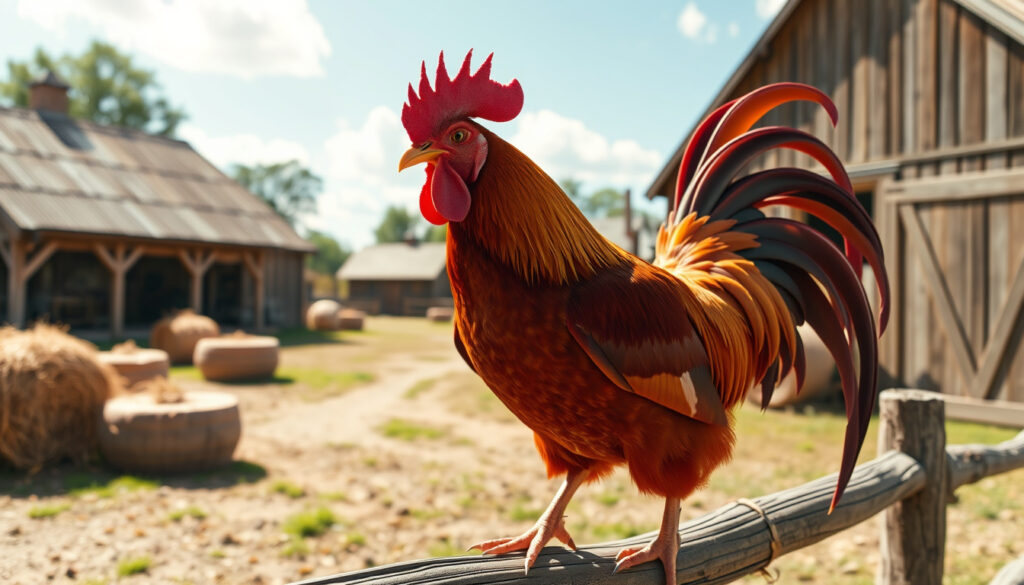
Foghorn Leghorn is an anthropomorphic rooster in Warner Bros. Looney Tunes and Merrie Melodies. He was created by Robert McKimson and first appeared in 1946 in “Walky Talky Hawky” (Wikipedia). Known for his Southern accent, tall stature, red head, and long tail feathers, Foghorn towers over most other barnyard characters — that size difference is half the comedy.
What are the physical characteristics of Foghorn Leghorn?
- Large, oversized rooster with a prominent red comb and wattle
- White feathers covering most of his body, consistent with the Leghorn breed
- Long, sweeping tail feathers that he often uses for dramatic effect
- Tall stature that makes him physically dominant over Henery Hawk and the Barnyard Dawg
Animation history specialist DIY.ORG describes him as a “comic rooster character known for a humorous Southern drawl and mischievous antics.” The implication: his physical presence matches his vocal one — a character built to dominate every scene he enters.
Which cartoons does Foghorn Leghorn appear in?
Foghorn appeared in 29 Warner Bros. cartoons during the Golden Age of Animation, from 1946 to 1963 (Villains Wiki). His first solo starring short was “The Foghorn Leghorn” in 1948. Later appearances include compilations, television series, and cameos in modern Warner Bros. productions.
With only 29 shorts across 17 years, Foghorn appeared less frequently than Bugs Bunny or Daffy Duck — but his recognizable voice and catchphrase earned him a permanent spot in pop culture memory.
What this means: Foghorn’s limited output makes his cultural footprint disproportionately large relative to his filmography.
Why is he called Foghorn Leghorn?
The name “Foghorn Leghorn” is a pun combining two distinct references. “Foghorn” refers to his loud, booming voice — like the foghorn signals used by ships in poor visibility (Wikipedia). “Leghorn” refers to the Leghorn breed of chicken, which originates from Livorno, Italy (Australiainsight.com). The character’s full name is a layered joke: a loud-mouthed rooster of a specific breed, labeled with a nautical pun.
The inspiration went deeper than just a name. According to Cartoon Research (animation history specialist), Robert McKimson later remembered Foghorn as an amalgam of two radio characters: The Sheriff — who yelled obnoxiously and prefaced repeated remarks with “I say” — and Senator Claghorn, a blustery Southern politician from Fred Allen’s radio show (Wikipedia).
The pattern: what sounds like a simple name pun actually carries a double radio-comedy inheritance. McKimson borrowed a vocal tic from one character and a personality type from another, then sealed it with a chicken breed and a nautical horn.
What bird is Foghorn Leghorn?
Foghorn Leghorn is a rooster — a male chicken — of the Leghorn breed. Leghorn chickens are known for being white-feathered and prolific egg layers (Wikipedia). The character is drawn as an oversized, anthropomorphic rooster with exaggerated male rooster features: a large red comb, long tail feathers, and a confident strut.
What breed of chicken is Foghorn Leghorn?
The Leghorn breed originates from the port city of Livorno, Italy. In the late 19th century, the breed was exported to America and became a staple of egg production. The name “Leghorn” is an English adaptation of “Livorno” (Australiainsight.com).
“I say, I say, I say! That’s a joke, son!”
— Foghorn Leghorn (voiced by Mel Blanc)
The trade-off: McKimson chose a real, recognizable breed rather than inventing a fictional one — grounding the character in farmyard reality while the comedy took flight.
What is Foghorn Leghorn’s famous line?
His most famous catchphrase is “I say, I say, I say!” — often delivered before a long-winded comment. Another well-known line is “That’s a joke, I say, that’s a joke, son!” (Ranker).
Why does Foghorn Leghorn say ‘I say, I say’?
The repetitive “I say” mimics a rhetorical tic of Southern radio orators from the 1940s. According to Ranker, it was one of the catchphrases of Senator Claghorn on Fred Allen’s radio show. Foghorn adopted the cadence and made it his own — turning a regional speech pattern into global cartoon shorthand for a loud, confident character.
For voice actors following Mel Blanc, that “I say” pattern is the hardest element to replicate: the timing demands a drawn-out first syllable and a rapid-fire second, like a train starting and stopping in the same breath.
The implication: the catchphrase’s rhythmic complexity is what makes it so memorable and difficult to imitate.
Who is Foghorn’s girlfriend?
Foghorn Leghorn’s girlfriend is Miss Prissy, a hen character who is often the object of Foghorn’s romantic advances. She first appeared in Foghorn shorts as a somewhat flustered but receptive partner to the rooster’s overconfident courtship.
Did Foghorn Leghorn have any other recurring characters?
Yes, two regulars defined Foghorn’s world: Henery Hawk (the chicken hawk) and the Barnyard Dawg. Henery is a young hawk who is constantly tricked by Foghorn into attacking the Barnyard Dawg instead. The Dawg, a grumpy, silent watchdog, serves as Foghorn’s primary foil and occasional victim.
- Henery Hawk: Young predator who repeatedly fails to catch Foghorn (Wikipedia)
- Barnyard Dawg: Silent antagonist who often gets the last laugh — or doesn’t
- Miss Prissy: Foghorn’s love interest, a hen with a soft spot for his bravado
What this means: Foghorn exists in a tightly wound triangle — rooster vs. dog via chicken hawk — with Miss Prissy as the reward that never quite arrives. The unrequited pursuit of her affection drives several shorts’ storylines.
What does fog horn mean in slang?
In slang, “foghorn” can refer to a loud, deep voice or a person with such a voice. The term originates from nautical foghorns — mechanical horns used by ships to warn other vessels in poor visibility (Wikipedia). The phrase “like a foghorn” describes a booming, resonant voice that carries across a room (or a barnyard).
Popular culture adopted the term for anyone who speaks with an attention-commanding volume. The slang meaning predates the cartoon but the character reinforced it: after Foghorn Leghorn became famous, calling someone a “foghorn” carried the additional connotation of comic bluster rather than just loudness.
“Foghorn Leghorn was directly inspired by Senator Claghorn, a blustery Southern politician on Fred Allen’s radio show.”
— Wikipedia
The catch: the slang meaning is now a two-way street. People call loud talkers “foghorns” without knowing the nautical origin, and they call confident blowhards “Foghorn Leghorns” without realizing they’re invoking a chicken breed and a radio comedian from the 1940s.
When was Foghorn Leghorn created?
Timeline
- 1946: Foghorn Leghorn debuted in “Walky Talky Hawky” (Toonopedia)
- 1948: First solo starring short “The Foghorn Leghorn”
- 1950s: Foghorn became a regular Looney Tunes character, appearing alongside Henery Hawk and Barnyard Dawg
- 1963: Final classic short “The Last Hungry Cat”
- 1990s–2000s: Foghorn appeared in compilations, TV series, and modern cameos
The pattern: Foghorn’s active period — 17 years of theatrical release — is shorter than Bugs Bunny’s or Porky Pig’s, but his post-1963 afterlife in syndication and pop culture references has been disproportionately large for a character with only 29 original shorts.
Confirmed facts
- Foghorn Leghorn is a Warner Bros. cartoon character created by Robert McKimson (Wikipedia)
- His first appearance was in 1946 in “Walky Talky Hawky” (Toonopedia)
- His catchphrase is “I say, I say, I say!” (Ranker)
- He is a rooster of the Leghorn breed (Wikipedia)
- His girlfriend is Miss Prissy
- The term “foghorn” is used in slang for a loud voice
- Foghorn was inspired by Senator Claghorn from Fred Allen’s radio show (Cartoon Research)
What’s unclear
- The exact number of shorts in which Foghorn appears varies by source (commonly cited as 29, but may include cameos) (Villains Wiki)
- Whether the name “Foghorn Leghorn” was inspired by a specific real foghorn or was purely a pun is not explicitly documented
youtube.com, internetpillar.com, hero.fandom.com, quotesanity.com, warnerbroscartoons.fandom.com
For a deeper look at how the rooster’s persona was patched together from 1940s radio satire, see Foghorn Leghorns satirical origins.
Frequently asked questions
How many Foghorn Leghorn cartoons were made?
29 theatrical shorts were produced between 1946 and 1963 (Villains Wiki).
What is the name of the chicken hawk in Foghorn Leghorn cartoons?
Henery Hawk is the young chicken hawk who repeatedly tries — and fails — to catch Foghorn (Wikipedia).
Is Foghorn Leghorn a chicken or a rooster?
He is a rooster — a male chicken — of the Leghorn breed (Wikipedia).
Did Foghorn Leghorn ever appear in a movie?
Yes, he appeared in compilation films like “The Bugs Bunny/Road Runner Movie” and later cameos in “Space Jam” (Wikipedia).
Who voiced Foghorn Leghorn after Mel Blanc?
Mel Blanc voiced the character until his death in 1989. Joe Alaskey later voiced Foghorn in later productions.
What is the Barnyard Dawg’s name?
The Barnyard Dawg is simply called “Barnyard Dawg” — he has no formal name in most shorts (Wikipedia).
Why does Foghorn Leghorn talk in a Southern accent?
The Southern accent models the voice of Senator Claghorn, a blustery Southern politician character from Fred Allen’s 1940s radio show (Wikipedia).
Who created Foghorn Leghorn?
Robert McKimson created the character for Warner Bros. in 1946 (Wikipedia).
Related reading
More related posts
 Ant Middleton: Conviction, SAS Exit & Amazing Race Controversy
 Batman (1989 Film): Cast, Plot, Tim Burton Direction
 GWM Tank 300 – 2026 Prices Specs Hybrid Australia
 Bec Hewitt: Life, Children, and Marriage in 2026
 Anne of Cleves: Great Survivor of Henry VIII’s Wives
 Tyrese Gibson: Is He Half White? Kids, Meme & Diddy Comments
 Grand Prix Melbourne 2026: Tickets, Dates, Schedule & Guide
 Sophie Cunningham: WNBA Player Who Won’t Stay in Her Lane
