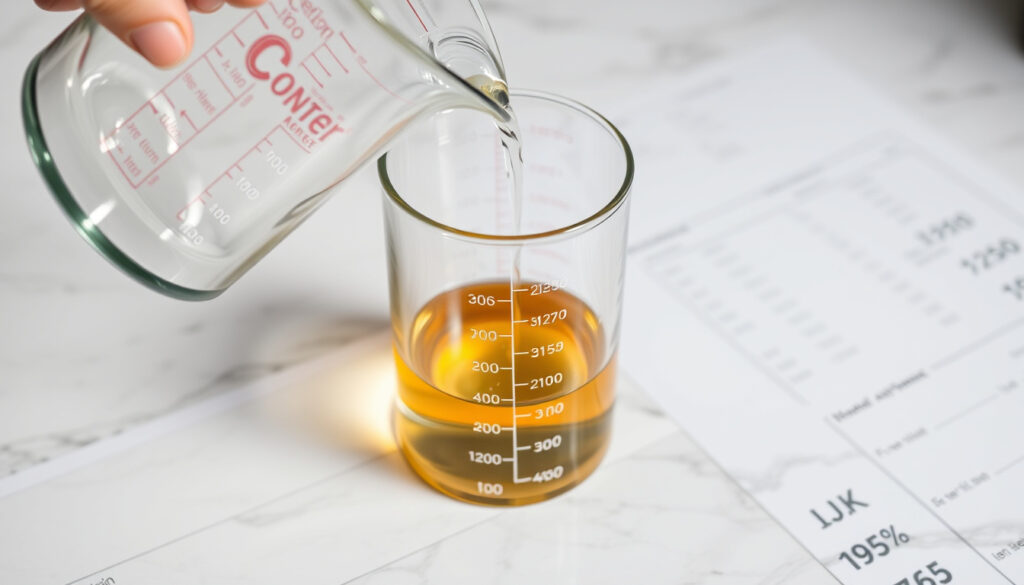
Ounce to Ml – Precise US and UK Conversion Tables
Converting ounces to milliliters is a common task in cooking, scientific work, and everyday measurements. The conversion depends on which system you are using, since the United States and the United Kingdom define their fluid ounces differently. This guide provides precise conversion tables, explains the difference between US and UK standards, and covers common fractional measurements you may encounter in recipes or lab work.
Understanding the exact conversion factor matters when precision is important. While some contexts allow rounding to 30 ml per ounce, professionals working in nutrition labeling, pharmaceuticals, or scientific research typically require the full decimal precision to avoid compounding errors across multiple measurements.
1 Ounce to ml
1 US fluid ounce = 29.57 ml
1 UK Imperial ounce = 28.41 ml
Formula: ml = fl oz × 29.5735 (US)
Formula: ml = fl oz × 28.4131 (UK)
The US fluid ounce is approximately 4% larger than the UK Imperial fluid ounce. When following recipes, always verify which system the author intended to avoid dosing errors.
Key Insights
Fluid ounces measure volume, not weight—confusion arises when people assume 1 oz always equals a specific gram amount
The US system uses 29.5735 ml per fluid ounce, defined by the National Institute of Standards and Technology
The UK Imperial system uses 28.4131 ml per fluid ounce, established historically and still used in some Commonwealth regions
For water at standard temperature, 1 ml equals approximately 1 gram due to water’s density of 1 g/ml
Nutrition labels often round to 30 ml per ounce for consumer-friendly numbers, which introduces small errors in precise applications
1 US cup equals exactly 8 fluid ounces or 236.59 ml, while UK cups may differ slightly
US Fluid Ounces
Milliliters (ml)
Notes
1 fl oz
29.57 ml
Base unit for US conversions
4 fl oz
118.29 ml
Half a cup
8 fl oz
236.59 ml
One standard US cup
16 fl oz
473.18 ml
One US pint
32 fl oz
946.35 ml
One US quart
8 Ounce to ml and Smaller Multiples
Converting 2 to 8 Ounces
Small multiples of ounces appear frequently in cooking measurements and beverage recipes. When converting 2 ounces to milliliters, multiply 2 by 29.5735 to get 59.15 ml using the US system. Three ounces equals 88.72 ml, and four ounces reaches 118.29 ml.
The value 8 ounces deserves special attention because it defines the standard US cup measurement. Eight US fluid ounces convert to 236.59 ml. This equivalence makes 8 ounces particularly useful in recipes, since many cooking instructions reference cup measurements alongside fluid ounce quantities.
Why Precision Matters in Recipes
Baking recipes especially require accurate conversions because ingredient ratios directly affect chemical reactions. A cake recipe calling for 4 ounces of milk needs 118.29 ml in US measurements. If someone uses the rounded approximation of 120 ml instead, the accumulated difference across multiple ingredients can noticeably alter texture and moisture content.
Professional kitchens often maintain calibrated measuring equipment to ensure consistency. Home cooks working from international recipes benefit from understanding these distinctions, particularly when converting British recipes that assume UK Imperial ounce values.
When converting UK recipes to metric measurements, subtract approximately 4% from the US fluid ounce value to account for the difference between Imperial and US definitions.
32 oz to ml and Larger Volumes
Converting Pint, Quart, and Gallon Measurements
Larger volume conversions become straightforward once you understand the base multiplier. Sixteen US fluid ounces equal one pint, which converts to 473.18 ml. The US quart measurement of 32 fluid ounces yields 946.35 ml—nearly one liter but falling short by approximately 54 ml.
A half-gallon contains 64 US fluid ounces, equaling 1892.71 ml. These larger conversions matter in food service, industrial cooking, and batch preparation where ingredients are measured in bulk quantities.
Common Large Volume Table
US Fluid Ounces
Milliliters
Common Description
16 fl oz
473.18 ml
1 US pint
24 fl oz
709.76 ml
1.5 US pints
32 fl oz
946.35 ml
1 US quart
40 fl oz
1182.94 ml
Refrigerator water bottle size
64 fl oz
1892.71 ml
Half gallon
Water Density and Weight Equivalents
Water serves as the reference substance for density measurements in most contexts. At standard temperature and pressure, water has a density very close to 1 gram per milliliter. This means that 236.59 ml of water weighs approximately 236.59 grams—a useful relationship when recipes specify ingredients by weight or volume interchangeably.
Other liquids vary in density. Oil is less dense than water, so a fluid ounce of oil weighs slightly less than a fluid ounce of water. Syrups and honey are more dense, meaning the same volume weighs considerably more. Professional recipe developers account for these differences when creating formulations.
1/2 Ounce to ml and Fractions
Converting Fractional Ounce Values
Recipes often call for fractional amounts like half an ounce or three-quarters of an ounce, particularly for concentrated ingredients, flavorings, or medications. Half a US fluid ounce equals 14.79 ml. Three-quarters of a US fluid ounce converts to 22.18 ml.
These smaller measurements require attention to precision since even minor deviations represent larger percentage errors. A difference of 0.5 ml in a medication dose or specialty chemical measurement could be significant. For such applications, using calibrated pipettes or graduated cylinders rather than standard kitchen measuring tools provides necessary accuracy.
Fractional Conversion Reference
Fraction
US Fluid Ounces
Milliliters (US)
Milliliters (UK)
1/4 oz
0.25 fl oz
7.39 ml
7.10 ml
1/2 oz
0.5 fl oz
14.79 ml
14.21 ml
3/4 oz
0.75 fl oz
22.18 ml
21.31 ml
Kitchen measuring spoons typically lack the precision required for scientific or medical applications. Always use appropriate laboratory glassware when fractional ounce measurements require accuracy beyond household tolerances.
Understanding the Two Standards
US vs UK Fluid Ounce Differences
The United States and United Kingdom developed separate volume measurement systems historically, and while both countries have moved toward metrication in many contexts, their fluid ounce definitions remain different. The US fluid ounce measures 29.5735 ml, while the UK Imperial fluid ounce equals 28.4131 ml.
This difference of approximately 4% means that 8 US fluid ounces produces 236.59 ml, while the same 8 UK Imperial fluid ounces yields only 227.30 ml. The gap widens proportionally with larger volumes, making system confusion increasingly significant in bulk cooking or industrial applications.
Where Each System Is Used
The US system predominates in the United States, Canada in some contexts, and most international recipes originating from American publications. The UK Imperial system appears in British cookbooks, some Commonwealth countries, and older recipe archives. Modern EU-influenced recipes typically use metric measurements exclusively.
Pharmaceutical and medical contexts in the US rely on precise volume measurements using fluid ounces, particularly for pediatric dosing where accuracy directly affects patient safety. These contexts typically employ the full precision factor of 29.5735 ml per US fluid ounce rather than rounded approximations.
Related Unit Conversions
Understanding fluid ounce conversions connects to other common measurement transformations. Converting milliliters back to ounces requires division: dividing milliliters by 29.5735 yields US fluid ounces. For example, 750 ml equals approximately 25.36 US fluid ounces.
The relationship between ounces and grams depends entirely on the substance being measured since grams measure mass while fluid ounces measure volume. Only for water and substances with similar density does 1 fluid ounce approximate 1 ounce by weight. Converting between pounds and kilograms follows a different principle entirely, since pounds also measure weight rather than volume.
For reverse conversions from milliliters to ounces, divide the milliliter value by 29.5735 for US measurements or by 28.4131 for UK Imperial measurements.
Sources and Standards Authority
The National Institute of Standards and Technology publishes the definitive reference values for US customary measurements in Handbook 44. NIST provides official conversion factors that regulatory bodies and scientific institutions reference for compliance and accuracy purposes.
The International Bureau of Weights and Measures maintains the international standard for metric units. While fluid ounces are not part of the official SI system, the conversion factors derive from precise definitions established through international agreement on basic measurement standards.
The US fluid ounce is defined as 1/128 of a US gallon, which itself is defined as 231 cubic inches. These relationships create the precise conversion factor of 29.5735 ml per fluid ounce.
— NIST Handbook 44, Appendix C
Reliability of Conversion Sources
Conversion calculators and tables vary in precision and accuracy. Government standards bodies like NIST provide verified values suitable for regulatory compliance. Commercial conversion tools may display rounded numbers for consumer convenience, which introduces small errors that accumulate in technical applications.
The USDA Food Buying Guide provides standard volume equivalents for food service professionals, including the relationship between fluid ounces and milliliters used in institutional cooking.
Summary
Converting fluid ounces to milliliters requires knowing which system applies: the US fluid ounce equals 29.5735 ml, while the UK Imperial fluid ounce equals 28.4131 ml. This 4% difference matters in precise applications like pharmaceuticals, baking, and scientific work. The conversion table provided here covers common values from fractional ounces through quart measurements, with water density notes explaining the gram relationship. Always verify which standard your recipe or application assumes before converting.
For quick reference, multiply fluid ounces by 29.57 for US measurements or by 28.41 for UK measurements. Reverse conversions divide milliliters by the same factors. Exploring other measurement conversions like height or weight follows similar principles of precision and system awareness.
Frequently Asked Questions
How many grams are in one fluid ounce of water?
One fluid ounce of water at standard temperature weighs approximately 29.57 grams, since water has a density of 1 g/ml. Other substances vary based on their density.
Is 1 oz the same as 30 ml?
No, 1 US fluid ounce equals 29.57 ml, not 30 ml. The approximation of 30 ml per ounce is commonly used for nutrition labeling but introduces a small error.
How many milliliters in a UK fluid ounce?
One UK Imperial fluid ounce equals 28.41 milliliters, which is approximately 4% smaller than the US fluid ounce.
How do I convert ml back to ounces?
Divide the milliliter value by 29.5735 for US fluid ounces or by 28.4131 for UK Imperial fluid ounces.
Why does the UK fluid ounce differ from the US?
The two systems developed independently with different historical definitions. The UK Imperial system was established earlier and uses a smaller volume for its base ounce unit.
How many ounces in a liter?
One liter equals approximately 33.81 US fluid ounces or 35.20 UK Imperial fluid ounces, using the respective conversion factors.
More related posts
 Dustin Martin: What He Does Now, Net Worth & Retirement
 Jameela Jamil: Disability, LGBTQ, Childhood & Career
 Pamela Anderson Spouse – 2025 Status and Marriage History
 One Punch Man Season 3 – Episodes, Studio & Reception Guide
 Is MSTR Stock a Buy? 2026 Forecast & Top Owners
 Drake Maye: Wife, Salary, Height, Tom Brady Comments & More
 Arsenal vs Bayern: Head-to-Head, 10-2 Thrashing & Next Match
