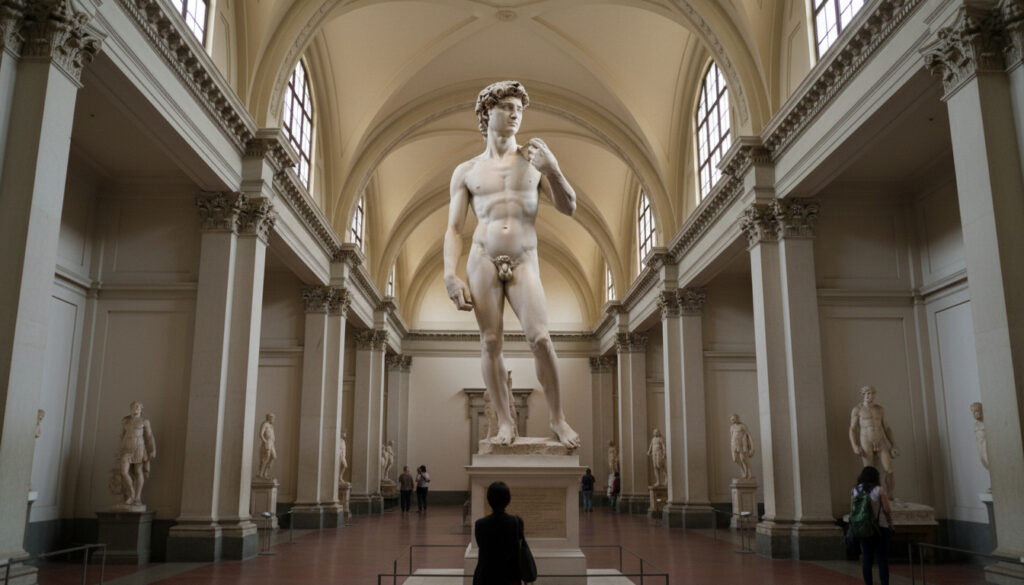
Statue of David – Location History Dimensions Florence
Michelangelo’s David stands as one of the most celebrated sculptures in Western art history. Carved from a single block of Carrara marble during the height of the Italian Renaissance, this 17-foot colossus continues to draw millions of visitors annually to its climate-controlled sanctuary in Florence.
Completed in 1504 after three years of intensive labor, the statue originally served as a potent political symbol for the Florentine Republic. Today, it represents the pinnacle of Renaissance artistic achievement while facing modern conservation challenges that ensure its survival for future generations.
Where Is the Statue of David Located?
The original Statue of David resides in the Tribune Hall of the Accademia Gallery in Florence, Italy. Architect Emilio De Fabris designed this custom-built circular room in the 19th century specifically to showcase the masterpiece. Natural light floods the space through a skylight, enabling visitors to examine the sculpture from a complete 360-degree perspective on the first floor.
- Occupies a purpose-built circular room constructed in the 19th century
- Positioned on the first floor beneath a skylight for natural illumination
- Relocated from its original outdoor position in 1873 to prevent weathering
- Transferred to its current Tribune Hall location in 1910
- Two full-scale replicas exist elsewhere in Florence for public viewing
- Environmental controls protect the marble from modern pollution
| Fact | Details |
|---|---|
| Current Location | Tribune Hall, Accademia Gallery, Florence |
| Display Level | First floor with skylight illumination |
| Height | 517 cm (17 feet) |
| Weight | 5,560 kg (5.5 tons) |
| Material | Single block of Carrara marble |
| Original Placement | Palazzo Vecchio entrance, Piazza della Signoria |
| Relocation Year | 1873 (to Accademia Gallery) |
| Tribune Transfer | 1910 (to current custom-built room) |
| Commission Date | August 16, 1501 |
| Completion Date | May 1504 (unveiled September 8, 1504) |
Who Created the Statue of David and When?
The Opera del Duomo commissioned Michelangelo on August 16, 1501, to complete a project that had stalled decades earlier. Agostino di Duccio had begun carving the marble block in 1464, intending it for the Florence Cathedral, but abandoned the effort. Antonio Rossellino attempted to resume work in 1475 but also failed to progress. The stone lay neglected in the cathedral courtyard for 25 years before Michelangelo undertook the commission.
The Sculpting Period
Michelangelo worked on the statue from September 1501 until May 1504, transforming the flawed marble into a representation of the Biblical hero. The Accademia Gallery records indicate the official unveiling occurred on September 8, 1504, sparking widespread admiration among Florentine citizens.
The marble block that became David sat exposed to the elements in the Opera del Duomo courtyard for 25 years before Michelangelo began work. Earlier sculptors had rejected the stone due to numerous imperfections called “taroli,” which made the tall, shallow block appear unsuitable for sculpture.
Location Selection
On January 25, 1504, a committee of approximately 30 prominent artists—including Leonardo da Vinci, Sandro Botticelli, Filippino Lippi, and Perugino—convened to determine the statue’s placement. After considering nine different proposals, they selected the entrance to Palazzo Vecchio in Piazza della Signoria, establishing it as a public symbol of Florentine strength.
How Tall Is the Statue of David and What Is It Made Of?
The sculpture measures exactly 517 centimeters (17 feet) in height and weighs 5,560 kilograms (5.5 tons). Official measurements from the Accademia Gallery confirm these specifications, making it substantially larger than life-size.
The Carrara Marble Block
Michelangelo carved the figure from a single block of Carrara marble, a material prized for its fine grain and pure white color. Museum documentation notes that the specific block had been quarried decades earlier for the cathedral project but was considered too technically challenging by previous artists due to its dimensions and internal flaws.
Visitors planning international travel to view such masterworks often monitor various rates and services. Those interested in TWD to AUD – Live Rate, Charts and Conversion Guide can find relevant financial data for trip planning.
Why Is the Statue of David Culturally Significant?
David emerged as the definitive symbol of liberty and Republican ideals for Florence. Positioned before the government palace, the statue represented the city’s readiness to defend itself against larger, more powerful adversaries, drawing parallels between the Biblical shepherd boy and the independent city-state.
Artistic Departure
Travel documentation confirms the sculpture depicts the Biblical hero as a standing male nude captured at the moment before confronting Goliath. This representation broke from medieval traditions that typically showed David triumphant after the battle.
Historical records indicate that portions of the sculpture originally featured gold leaf applications. The garland on David’s head, the tree trunk (broncone) behind his right leg, and his slingshot all appeared gilded when the statue first stood in Piazza della Signoria.
Museum records confirm that two full-scale replicas stand elsewhere in the city. A marble copy occupies the sculpture’s original position in Piazza della Signoria, while a bronze version overlooks Florence from Piazzale Michelangelo, allowing visitors to appreciate the work in its historical contexts.
How Has the Statue of David Journeyed Through Time?
- : Agostino di Duccio begins preliminary work on the marble block intended for Florence Cathedral.
- : Antonio Rossellino briefly continues the abandoned project before ceasing work.
-
: The Opera del Duomo commissions Michelangelo to complete the sculpture.
Source: Accademia.org - : An artistic committee selects Palazzo Vecchio as the statue’s initial location.
-
: The completed sculpture is unveiled to the city of Florence.
Source: Galleria dell’Accademia -
: Authorities move the statue to the Accademia Gallery to protect it from environmental deterioration after more than three centuries in Piazza della Signoria.
Source: Accademia.org -
: The statue is formally transferred to the newly constructed Tribune Hall within the gallery.
Source: Florence Museum -
: Conservation specialists conduct a careful cleaning of the marble surface.
Source: Galleria dell’Accademia
What Do We Know for Certain About the Statue of David?
| Established Information | Information That Remains Unclear |
|---|---|
| Michelangelo served as the sole carver from 1501-1504 | Specific details regarding alleged toe damage incidents |
| The statue weighs exactly 5,560 kilograms | Current comprehensive visiting logistics and ticket pricing |
| It was carved from a single Carrara marble block | Definitive documentation of circumcision depiction specifics |
| Relocated to the Accademia Gallery in 1873 | Any updates or changes implemented in 2023-2026 |
| Original placement was Palazzo Vecchio entrance | Exact monetary costs for contemporary conservation efforts |
What Historical Context Shaped the Statue of David?
The commission emerged during a period of intense civic pride in Republican Florence. The Opera del Duomo sought sculptures to adorn the cathedral, but the project evolved into a political statement. When the committee of 30 artists, including Leonardo da Vinci and Sandro Botticelli, selected the Palazzo Vecchio placement, they positioned David as a guardian of civic liberty, embodying the city’s independent spirit against larger regional powers.
The sculpture’s nudity and heroic scale reflected Renaissance humanist ideals, celebrating the human form as worthy of artistic perfection. This approach marked a decisive break from Gothic traditions, establishing new standards for anatomical accuracy and emotional expression in marble.
What Do Museum Records Reveal?
The marble block had lain neglected in the Opera del Duomo courtyard for 25 years before Michelangelo undertook the work.
— Accademia Gallery Documentation
David became the symbol of liberty and freedom of Florence’s Republican ideals, representing the city’s readiness to defend itself against external threats.
— Historical Analysis, Accademia.org
Why Does the Statue of David Remain Essential Viewing?
The sculpture continues to serve as the definitive testament to Renaissance artistic achievement, combining technical mastery with political symbolism. Its protected status within the Accademia Gallery ensures preservation while allowing intimate public access. For travelers requiring assistance with telecommunications during their visit, the Vodafone Customer Service Number – Official UK Helpline Guide provides relevant contact information.
Frequently Asked Questions
Why is the Statue of David important?
It represents the pinnacle of Renaissance sculpture and served as the symbol of Florence’s Republican liberty and independence from more powerful city-states.
What happened to the toe of the Statue of David?
Available museum records do not provide specific details regarding toe damage incidents. Conservation efforts focus on overall preservation rather than documenting isolated damage events.
Is the Statue of David circumcised?
Scholarly sources confirm the sculpture depicts a male nude consistent with Biblical representations of David, though specific anatomical details regarding circumcision are not documented in available Accademia Gallery records.
Why is the David statue nude?
The nudity reflects Renaissance humanist ideals celebrating the human form as perfected nature, while also referencing Classical Greek and Roman artistic traditions of heroic nudity.
How can I visit the Statue of David?
The original sculpture is housed in the Accademia Gallery’s Tribune Hall in Florence. Two replicas stand in Piazza della Signoria and Piazzale Michelangelo for alternative viewing.
More related posts
 Eddie Mabo: The Man Behind the Landmark Native Title Decision
 James Johnston: Australian Country Singer Biography & Songs
 120 Pounds in kg – Exact Conversion and Precision Guide
 Sean Combs: Prison Sentence, Pardon Questions, and Celebrity Reactions
 Panwaburi Beachfront Resort: Good? Cost, Location & Reviews
 The Gentlemen (2024 TV Series) – Cast, Plot, Episodes & Reviews
 Linen Pants for Women: Best Zara, H&M Styles Ireland
 Paul Mescal: Relationship, Net Worth, Movies & Facts
