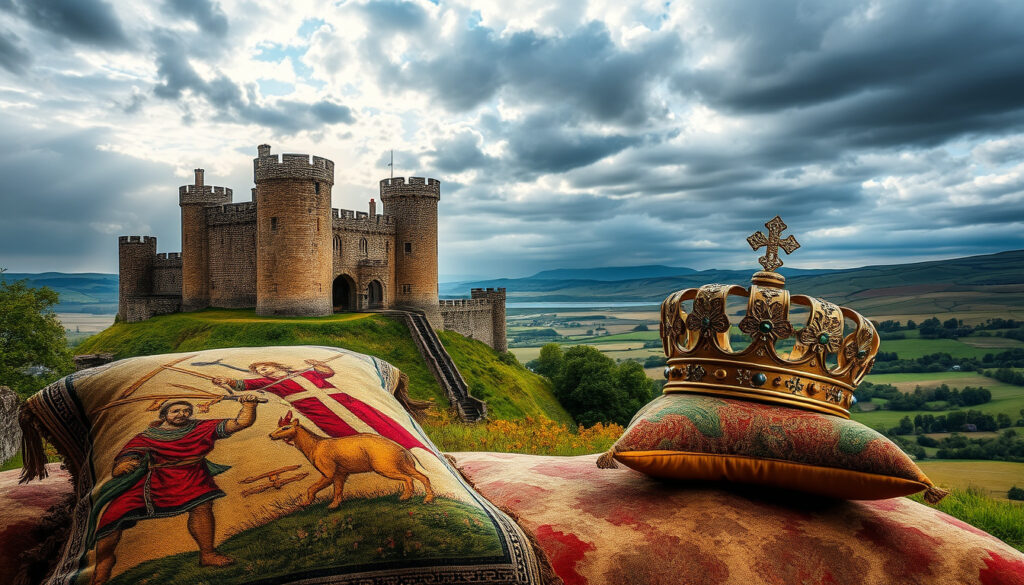
William the Conqueror: Life, Reign, and Legacy of England’s Norman King
Few moments in English history still spark debate quite like the Norman Conquest, which reshaped language, land ownership, and legal systems for centuries. But how much of what we know about William the Conqueror comes from reliable sources, and how much from later storytelling?
Born: c. 1028 in Falaise, Normandy ·
Died: 9 September 1087 in Rouen, Normandy ·
Reign as King of England: 25 December 1066 – 9 September 1087 ·
Known for: Norman Conquest of England in 1066 ·
Spouse: Matilda of Flanders (married c. 1051/1052) ·
Successor: William II (Rufus)
Quick snapshot
- William won the Battle of Hastings on 14 October 1066 (The Royal Family)
- He commissioned the Domesday Book (The Royal Family)
- He died on 9 September 1087 (The Royal Family)
- Exact wording of William’s deathbed speech is not definitively known (BBC History)
- Whether Edward the Confessor designated Harold as heir remains uncertain (The National Archives blog)
- Details of William’s early childhood are sparse (The Royal Family)
- c. 1028: William born in Falaise (The Royal Family)
- 14 Oct 1066: Battle of Hastings (The Royal Family)
- 25 Dec 1066: Crowned king (The Royal Family)
- 9 Sep 1087: Dies in Rouen (The Royal Family)
- William’s death triggered war between his sons Robert and William (Wikipedia)
- Modern dramas like King & Conqueror continue to shape public perception (DiscoverBritain)
Six snapshot facts, one pattern: the bare outlines of William’s life are well documented, but the details that drive popular imagination—his final words, the legitimacy of his claim, the drama of his family—remain contested.
| Key fact | Detail |
|---|---|
| Reign | 1066–1087 |
| Successor | William II (Rufus) |
| Spouse | Matilda of Flanders (m. c. 1051/52) |
| Children | At least 9, including William II and Henry I |
| Father | Robert I, Duke of Normandy |
| Burial | Abbey of Saint-Étienne, Caen, France |
What is William the Conqueror most known for?
The Norman Conquest of England
- William defeated Harold Godwinson at the Battle of Hastings on 14 October 1066 (BBC History).
- He was crowned King of England on 25 December 1066 (BBC History).
- His reign introduced Norman culture, language, and feudalism to England.
William’s claim to the English throne rested on Edward the Confessor’s alleged deathbed promise and an oath Harold supposedly swore in 1064 (The National Archives blog). The National Archives blog notes that the Bayeux Tapestry shows Edward reaching out to Harold, but the inscription does not explain the gesture, leaving modern historians to debate its meaning (The National Archives blog).
Establishment of Norman rule
Once crowned, William set about securing his new kingdom. He replaced almost all Anglo-Saxon bishops and abbots with Norman counterparts, ordered the construction of stone castles including the Tower of London, and commissioned the Domesday Book, a comprehensive survey of landholdings completed in 1086 (The Royal Family). The implication: William’s legacy is as much about administration as conquest—the Domesday Book remains an unparalleled record of medieval England.
How accurate is King and Conqueror?
Major historical inaccuracies in the series
- The BBC drama King & Conqueror takes dramatic liberties with timelines, character motivations, and events (DiscoverBritain).
- Historians believe Edward the Confessor may have asked William to be his successor, but not by the means or timing suggested by the drama (DiscoverBritain).
- Historia Magazine‘s review says the first episode makes a strong claim to true history but is not fully accurate (Historia Magazine).
Wikipedia’s entry on the series notes praise for acting but criticism for pacing and historical inaccuracies (Wikipedia). The catch: entertainment value often wins over documentary precision, leaving viewers with an impression that the historical record is more dramatic—and more settled—than it actually is.
Audiences who watch King & Conqueror get a gripping story but miss the messy, unresolved debates over oaths, deathbed promises, and Harold’s family. The real 1066 was a political thriller—but the drama needs to stick closer to the primary sources to earn its claim of telling “true history.”
The catch: modern audiences should approach dramatizations with a critical eye.
What did William the Conqueror say on his deathbed?
Accounts of William’s final words
The following table summarizes the main chronicler accounts.
| Chronicler | Reported content | Reliability |
|---|---|---|
| Orderic Vitalis (12th c.) | William lamented persecuting the English beyond reason and expressed desire to return stolen goods | High but not eyewitness (BBC History) |
| Anglo-Saxon Chronicle | Reports regret and bequests to his sons; exact phrasing varies | Contemporary but sparse |
| Royal Family record | William left Normandy to Robert, England to William Rufus, and Henry 5,000 pounds in silver | High (Wikipedia) |
BBC History cautions that Orderic Vitalis probably did not have an eyewitness account of William’s last words (BBC History). The bottom line for historians: no single universally accepted deathbed quote exists. What is clear is that William divided his dominions before death, a choice that triggered conflict among his sons.
The pattern: the deathbed scene remains a blend of fact and interpretation.
Was William the Conqueror Viking?
William’s Norman ancestry
- William was of Norman descent; Normans were descended from Vikings (Norse settlers) who settled in Normandy in the 10th century (Wikipedia).
- By William’s time, Normans were culturally French, spoke Old French, and practiced Christianity.
- Historians classify William as a Norman, not a Viking.
The distinction matters: while William’s ancestors were Scandinavian raiders, his identity was thoroughly Frankish. The claim that he was “Viking” is technically true in a genealogical sense but misleading about his culture and politics.
What happened to William’s wife Matilda on 11 May 1068?
Coronation of Matilda of Flanders
Matilda was crowned Queen consort of England at Westminster Abbey on 11 May 1068 (Wikipedia). This was a key event legitimizing William’s new dynasty. She later served as regent in Normandy during William’s absences, demonstrating her political importance beyond ceremonial roles. The pattern: Matilda’s coronation was not a mere formality—it signaled to both English and Norman elites that the new royal line had a stable partnership at its core.
Modern dramatizations often downplay Matilda’s political agency. The historical record shows she was a capable regent and a central figure in William’s reign—her story deserves more attention than a single coronation date.
The implication: Matilda’s role deserves more recognition in popular history.
Timeline: William’s life in key dates
- c. 1028: William born in Falaise, Normandy (The Royal Family)
- 1035: Becomes Duke of Normandy upon his father’s death (Wikipedia)
- c. 1051/1052: Marries Matilda of Flanders (Wikipedia)
- 14 Oct 1066: Battle of Hastings; defeats Harold Godwinson (BBC History)
- 25 Dec 1066: Crowned King of England (BBC History)
- 11 May 1068: Matilda crowned Queen of England (Wikipedia)
- 1086: Domesday Book completed (Wikipedia)
- 9 Sep 1087: William dies in Rouen, Normandy (Wikipedia)
This sequence shows William’s trajectory from a vulnerable child duke to the most powerful ruler in Britain. The gap between 1068 and 1086 is filled with castle building, land redistribution, and constant campaigns—a reign of consolidation as much as conquest.
What is confirmed, what remains unclear
Confirmed facts
- William won the Battle of Hastings in 1066 (BBC History).
- He commissioned the Domesday Book (Wikipedia).
- He died on 9 September 1087 (Wikipedia).
- He was crowned on 25 December 1066 (BBC History).
What’s unclear
- Exact wording of William’s deathbed speech is not definitively known (BBC History).
- The precise nature of Harold Godwinson’s first relationship (marriage vs. handfast) is uncertain (Wikipedia).
- Details of William’s early childhood and education are sparse (Wikipedia).
- Whether Edward the Confessor designated Harold as heir remains uncertain (The National Archives blog).
The ratio leans toward confirmed—most of the major events are fixed in the historical record. The uncertainties cluster around personal conversations (deathbed words) and marriage customs that were less formal than today.
Voices from the past
“William lamented that he had persecuted the English beyond reason, and commanded that all his prisoners be freed and his stolen goods restored.”
— Orderic Vitalis, 12th-century chronicler, as reported by BBC History
“The Bayeux Tapestry shows Edward reaching out to Harold, but the inscription does not explain the gesture. The deathbed bequest to Harold cannot be proven with certainty.”
— The National Archives blog
These perspectives from medieval chroniclers and modern archivists underline the same truth: what we know about 1066 is filtered through fragmentary sources. Each generation puts its own spin on the story.
Why this matters now
For modern audiences, the stakes of getting William’s story right are not academic. When King & Conqueror compresses events and simplifies motivations, it shapes how millions of people understand the founding moment of English national identity. For historians, the choice is clear: keep pushing the public conversation back to the primary sources, or let dramatic license rewrite the past.
Related reading: **King & Conqueror historical accuracy** (this article is about the BBC drama that directly covers William the Conqueror’s invasion, which is the central focus of the research) · **Arthur Guinness: Real Story, Family, and Legacy | Fact vs Fiction**
penelope.uchicago.edu, youtube.com, en.wikipedia.org, reddit.com, familysearch.org, youtube.com
For a comprehensive account of his early years and the Norman campaign, William the Conquerors biography offers a detailed narrative.
Frequently asked questions
Who was William the Conqueror?
William the Conqueror was the first Norman king of England, reigning from 1066 to 1087. He led the Norman Conquest of England, defeating Harold Godwinson at the Battle of Hastings (BBC History).
How old was William when he became king?
William was about 38 years old when he was crowned on 25 December 1066 (born c. 1028).
What is the Domesday Book?
The Domesday Book is a comprehensive survey of landholdings in England commissioned by William in 1086, used for taxation and administration (Wikipedia).
Where is William the Conqueror buried?
He is buried in the Abbey of Saint-Étienne in Caen, France.
Was William the Conqueror related to the Vikings?
Yes, his Norman ancestors were Viking settlers who established the duchy of Normandy in the 10th century. By William’s time, however, Normans were culturally French (Wikipedia).
How many children did William the Conqueror have?
William had at least nine children with Matilda of Flanders, including two future kings: William II (Rufus) and Henry I.
More related posts
 The Chestnut Man – Ending Explained Plot Cast Guide
 Cathy Freeman: Medical Condition, Asthma, and The Bodysuit Explained
 Larry Hagman: Biography, Cause of Death, and Alcohol Battle
 Becky Lynch: Biography, Career, and Family Life
 Jameela Jamil: Disability, LGBTQ, Childhood & Career
 Rayan Cherki: Parents, Religion, Height, and Career Facts
 Lorraine Bracco: Biography, Career, and Life Today
 Peta and Jain: Luxury, Sustainability & Quality Review
